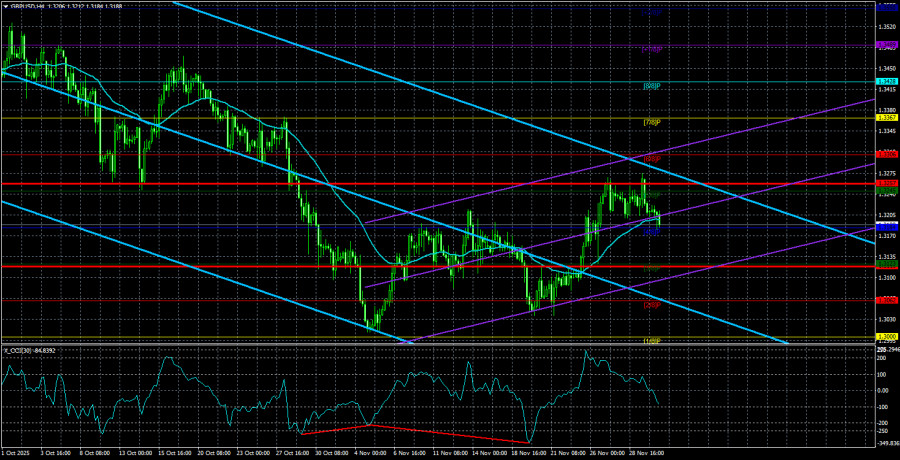
The GBP/USD currency pair traded relatively weakly on Tuesday, as expected given the absence of significant macroeconomic events in both the UK and the US. The most notable event of the day was Donald Trump's statement that he has decided on a new Federal Reserve chair, "the name of whom will be announced later." Nevertheless, the British currency is gradually appreciating, and it is important to remember that any trend begins with a slight movement.
Several interesting technical moments emerged on Tuesday and are worth analyzing. Firstly, the GBP/USD pair failed to overcome the moving average line, which means that the upward trend remains. Secondly, during the European trading session, the price gained liquidity on buy orders from several recent local lows. Of course, one should not expect a 500-pip rise following such local signals, but the British pound has a fair chance to continue its moderate strengthening.
Many experts have become skeptical about the British currency in recent months. We believe this is due to GBP dynamics, which have not always aligned with macroeconomic data and fundamentals. Often, the pound has fallen without any real justification. The market has diligently ignored the continuous stream of negativity from across the ocean. For example, the dollar did not recover from the "shutdown" or the two rate cuts by the Fed.
The latest rise of the American currency began on the very day the Fed decided to resume easing monetary policy. Since then, the Fed has only been lowering rates, and the dollar has been appreciating. Thus, we find that the decline of the pair over the last 2.5 months is illogical. Therefore, we expect (as before) growth going forward.
Overall, the global fundamental backdrop remains unchanged for both the pound and the dollar. The dollar has accumulated a range of factors leading to its decline, which would be sufficient for several years ahead. We won't list them again, but the trend is still upward, as shown clearly on the daily chart. Yes, the correction has been much stronger than we anticipated, and even now, there is no confidence that it has ended. However, the market also cannot continue to ignore the fundamentals indefinitely.
Next week, the Fed will hold its last meeting of the year, and the probability of a third consecutive rate cut stands at nearly 90%. This is even without the latest, relevant reports on the labor market and unemployment. If the upcoming Non-Farm Payrolls and unemployment reports do not deliver positive results again, the dollar's outlook will worsen further. The Fed may indeed have to overlook rising inflation because the labor market decline needs to be halted. Next year, the new Fed chair will also advocate for rate cuts.

The average volatility of the GBP/USD currency pair over the last five trading days is 69 pips, which is considered "average" for this pair. On Wednesday, December 3, we expect movement within a range bounded by 1.3119 and 1.3257. The upper linear regression channel is directed downward, but this is solely due to technical corrections on higher timeframes. The CCI indicator has entered the oversold area 6 times in recent months and has formed another "bullish" divergence, consistently signaling a potential resumption of the upward trend.
The GBP/USD currency pair is trying to resume the upward trend of 2025, and its long-term prospects remain unchanged. Donald Trump's policies will continue to exert pressure on the dollar, so we do not expect the American currency to rise. Consequently, long positions with targets at 1.3306 and 1.3428 remain relevant for the near term as long as the price is above the moving average. If the price is located below the moving average line, small short positions can be considered with a target at 1.3062 on technical grounds. The American currency shows corrections from time to time (on a global scale), but for substantial strengthening, it needs signs of an end to the trade war or other positive global factors.
ForexMart is authorized and regulated in various jurisdictions.
(Reg No.23071, IBC 2015) with a registered office at First Floor, SVG Teachers Co-operative Credit Union Limited Uptown Building, Corner of James and Middle Street, Kingstown, Saint Vincent and the Grenadines
Restricted Regions: the United States of America, North Korea, Sudan, Syria and some other regions.












 আমাদের সাথে যোগাযোগ করুন