
Today, Thursday, the pair attracted buyer interest as it attempted to recover yesterday's losses; however, the attempt was unsuccessful, and the pair remained at the same price level. Current prices show no confidence in growth, hovering just above the 200-day SMA. The U.S. dollar index made attempts to recover today, which provided important support for USD/CAD.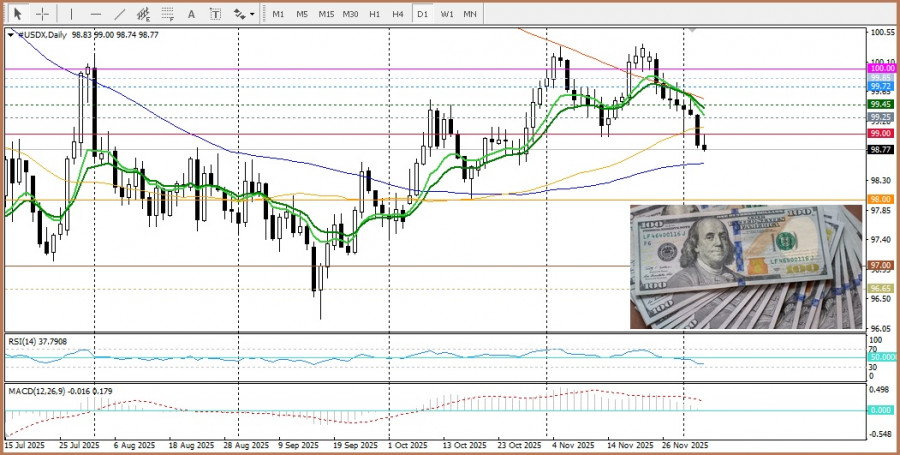 Nonetheless, significant dollar strengthening should not be expected, as most market participants anticipate that the Federal Reserve will cut rates next week in December. These expectations were reinforced by the weak ADP employment report, which showed that private-sector employers unexpectedly cut 32,000 jobs in November, despite today's labor data being better than previous figures.
The data indicate a weakening U.S. labor market and add to signs of slowing growth in the world's largest economy, increasing the likelihood of continued Fed easing. This sharply contrasts with the hawkish statements from the Bank of Canada, which pointed to a possible end to the rate-cutting cycle. Also supporting the Canadian dollar is the rise in oil prices, which benefits the commodity-linked Canadian currency and restrains further strengthening of USD/CAD.
Now the key indicators for trading the pair are the U.S. Personal Consumption Expenditures (PCE) Price Index, to be published on Friday, and the Canadian unemployment rate, also set for release on Friday during the North American session.
From a technical perspective, last week's price drop below the 100- and 200-period SMAs on the 4-hour chart favors the bears. Oscillators on both the 4-hour and daily charts are negative. However, it is important to note that on the daily chart the pair has not fallen below the very important 200-day SMA. This indicates that the pair is not yet ready for a major long-term decline.
Price resistance was met at 1.3983, just below the psychological 1.4000 level. Support for the pair is expected at the 200-day SMA.

RYCHLÉ ODKAZY
ForexMart is authorized and regulated in various jurisdictions.
(Reg No.23071, IBC 2015) with a registered office at First Floor, SVG Teachers Co-operative Credit Union Limited Uptown Building, Corner of James and Middle Street, Kingstown, Saint Vincent and the Grenadines
Restricted Regions: the United States of America, North Korea, Sudan, Syria and some other regions.











 Kontaktujte nás