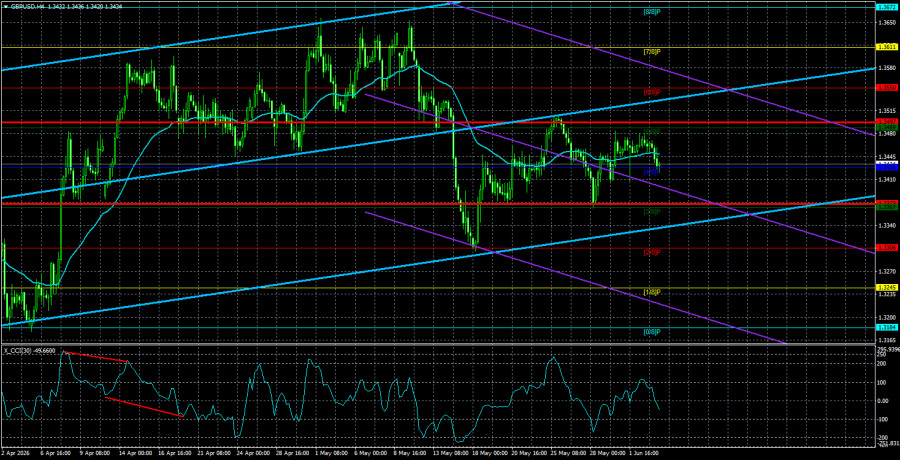
The GBP/USD currency pair continued to trade with low volatility on Wednesday. Macroeconomic data again had little to no impact on the pair's movement, which is not surprising—this is the trend we have observed for three consecutive months. Therefore, the business activity indices or the ADP and JOLTs reports are now little more than interesting figures. The market is fully focused on the Iranian conflict, but in a very peculiar way, for which we can thank Donald Trump. The market is now only prepared to react to confirmed information that affects the actual situation in the Middle East, the blockade of the Strait of Hormuz, energy prices, and so on. Hundreds of reports about the termination of negotiations, resumption of talks, new ceasefire violations, and imminent agreements are simply ignored by the market. Because this information is either unverified or has no real impact.
For example, what is the point of reacting to another ceasefire violation by Iran and the US if it brings no consequences? In the last two weeks, the parties have fired missiles at enemy positions about five times. What impact has this had? What is the point of reacting to Trump's repeated promises of a forthcoming agreement with Iran if this information also brings no consequences? Trump has been promising a deal for at least several weeks, and yet nothing has changed. What is the point of reacting to potential concessions from Washington or Tehran if such information is unconfirmed and often contradicted by the opposing side within hours?
The market has come to fully realize that Iran will not abandon uranium enrichment, and Washington will not abandon its goal of denuclearizing Iran. The situation is completely deadlocked. Thus, we believe that the conflict in the Middle East will persist for a long time, but the parties will not engage in daily active hostilities. The active phase of the war in February and March showed that the US cannot conquer Iran, that the assassination of Iranian leaders does not lead to regime change, there will be no national revolution, and the US will not succeed in persuading Iran to sign a favorable deal using those methods. As for Iran, it did not initiate this war and has the same right to possess nuclear weapons and develop them as the US does. Therefore, Tehran is certainly not interested in resuming the war.
Consequently, we do not see substantial reasons for a new strong dollar trend. Geopolitics supported the American currency in 2026. Without that support, the GBP/USD pair would already be above the 40 level. However, the dollar has gained some time but has not broken the negative trend that began last year when Trump came to power. Thus, we should not expect a deal now, but rather a shift in market attention from geopolitics back to the economy.
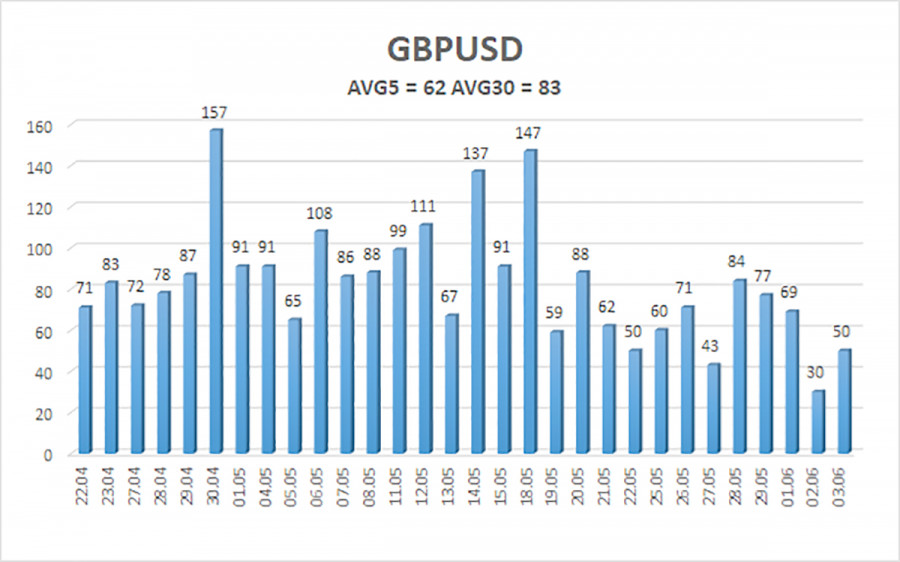
The average volatility of the GBP/USD pair over the last five trading days is 62 pips, which is considered "average" for this pair. On Thursday, June 4, we expect the pair to move within the range bounded by 1.3373 and 1.3497. The upper channel of linear regression is directed upwards, indicating a recovery of the upward trend. The CCI indicator has not formed any signals recently.
The GBP/USD pair continues to recover after a 300-pip drop. Trump's policies will continue to exert pressure on the US economy, so we do not expect long-term growth in the US dollar. However, 2026 is currently looking very positive for the dollar due to geopolitical factors. Thus, long positions targeting 1.3550 and 1.3611 can be considered if the price is above the moving average. If the price is below the moving average, short positions can be opened with targets at 1.3367 and 1.3306 on geopolitical grounds. The market situation often changes, and it continues to focus predominantly on geopolitical news that lacks uniformity. Given the current weak movements, it is advisable to trade on lower timeframes.
RYCHLÉ ODKAZY
ForexMart is authorized and regulated in various jurisdictions.
(Reg No.23071, IBC 2015) with a registered office at First Floor, SVG Teachers Co-operative Credit Union Limited Uptown Building, Corner of James and Middle Street, Kingstown, Saint Vincent and the Grenadines
Restricted Regions: the United States of America, North Korea, Sudan, Syria and some other regions.









 Kontaktujte nás