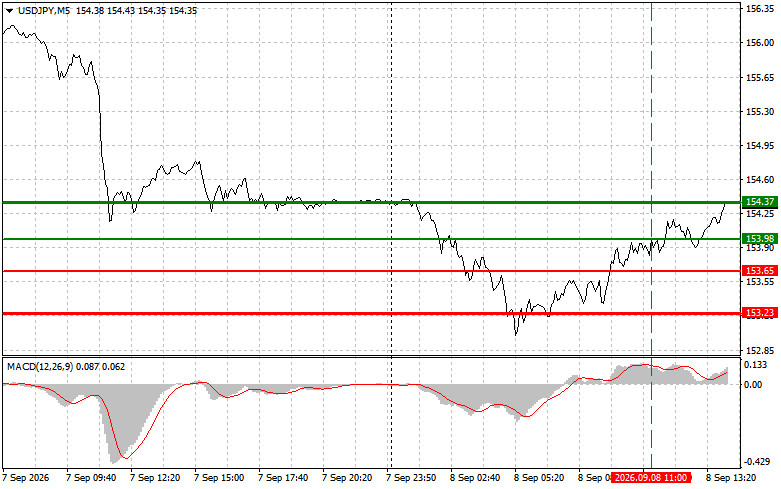
The price test of 155.98 occurred when the MACD indicator had already moved significantly upward from the zero line, limiting the pair's upward potential. For this reason, I did not buy the dollar.
In the second half of the day, the market will focus on the NFIB Small Business Optimism Index and U.S. consumer credit data. These indicators are secondary, but in my view, strong data could provide additional support for the dollar and extend its morning advance, which occurred immediately after the Bank of Japan moved away from currency intervention and the positive GDP data had already been priced in. However, I would not expect a strong rise in the pair, as I consider the strengthening expectations of a rate hike on September 18 to be the main factor supporting its upside. I believe that even relatively strong U.S. data will struggle to push the pair higher against this trend. This is why I do not expect secondary U.S. data to reverse the current sentiment in USD/JPY, as the fundamental shift in the Bank of Japan's policy, combined with direct market support, remains a much more significant factor. In my view, dollar buyers against the yen still have to take the risk of another intervention into account, so attempts by the pair to rise may quickly lose momentum.
As for the intraday strategy, I will focus more on the implementation of Scenarios #1 and #2.
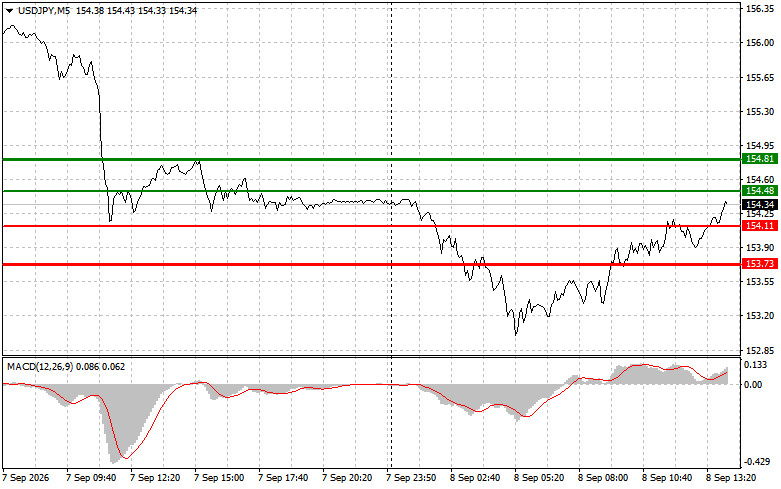
Scenario #1: Today, I plan to buy USD/JPY when the entry point is reached around 154.48 (the green line on the chart), targeting a rise toward 154.81 (the thicker green line on the chart). Around 154.81, I will exit the long position and open a short position in the opposite direction, targeting a 30–35-point move in the opposite direction from that level. A rise in the pair can be expected today, but the upward potential is relatively limited. Important! Before buying, make sure that the MACD indicator is above the zero line and has only just begun to rise from it.
Scenario #2: I also plan to buy USD/JPY today if the price makes two consecutive tests of 154.11 while the MACD indicator is in the oversold area. This would limit the pair's downward potential and lead to an upward reversal. A rise toward the opposite levels of 154.48 and 154.81 can be expected.
Scenario #1: Today, I plan to sell USD/JPY after a break below 154.11 (the red line on the chart), which should lead to a rapid decline in the pair. The key target for sellers will be 153.73, where I will exit the short position and immediately open a long position in the opposite direction, targeting a 20–25-point move in the opposite direction from that level. Downward pressure on the pair will return if the Bank of Japan intervenes. Important! Before selling, make sure that the MACD indicator is below the zero line and has only just begun to decline from it.
Scenario #2: I also plan to sell USD/JPY today if the price makes two consecutive tests of 154.48 while the MACD indicator is in the overbought area. This would limit the pair's upward potential and lead to a downward reversal. A decline toward the opposite levels of 154.11 and 153.73 can be expected.
Important. Beginner Forex traders should exercise extreme caution when making market-entry decisions. Before the release of important fundamental reports, it is best to stay out of the market to avoid exposure to sharp exchange-rate fluctuations. If you decide to trade during news releases, always place stop orders to minimize losses. Without stop orders, you can lose your entire deposit very quickly, especially if you do not use proper money management and trade large volumes.
And remember that successful trading requires a clear trading plan, such as the one presented above. Making spontaneous trading decisions based on the current market situation is inherently a losing strategy for an intraday trader.

RYCHLÉ ODKAZY
ForexMart is authorized and regulated in various jurisdictions.
(Reg No.23071, IBC 2015) with a registered office at First Floor, SVG Teachers Co-operative Credit Union Limited Uptown Building, Corner of James and Middle Street, Kingstown, Saint Vincent and the Grenadines
Restricted Regions: the United States of America, North Korea, Sudan, Syria and some other regions.











 Kontaktujte nás