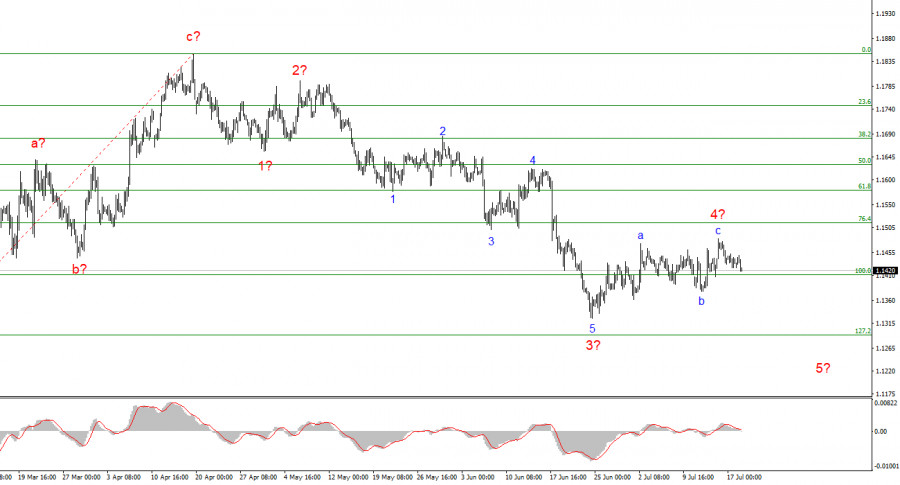
The wave structure on the 4-hour chart for EUR/USD has become more complex. There is still no indication that the upward trend segment (shown in the lower chart), which began in January of last year, has been invalidated. However, the trend structure has now taken on a corrective form. From a long-term perspective, wave C is expected to develop, with its low projected below the low of wave A. At present, the low of wave C is already below the low of wave A, meaning wave C could be completed at any time. Nevertheless, if the news backdrop remains favorable for the U.S. dollar, this wave could extend significantly further.
On the lower time frame, I can identify a classic five-wave bearish structure. If this assumption is correct, wave 4 is currently unfolding, while wave 3 has formed as a five-wave pattern. Once this structure is complete, the instrument may transition into a new upward wave sequence. However, according to the current wave count, wave 5 is still expected to develop. Therefore, the euro may decline toward the 1.13 level.
The EUR/USD pair declined by 20 basis points on Monday, once again displaying very limited price movement. Nevertheless, even such a modest decline is sufficient to suggest that wave 5 within wave C may be beginning. The reason is that all of the recent waves have been relatively small in size. Wave 4 could still develop into a more extended five-wave structure, but according to classical Elliott Wave principles, it should ideally form as a three-wave correction. Therefore, it may already be complete. If this assumption is correct, the market is now at the very beginning of wave 5 within wave C.
The euro is unlikely to receive meaningful support from this week's news flow. The week's key event—the European Central Bank's policy meeting—is expected to end with monetary policy remaining unchanged. If the market ignored the ECB's policy tightening a month and a half ago, it may begin another round of euro selling if interest rates are left unchanged. Recent price action suggests that market participants may already be positioning ahead of the ECB meeting.
It is also important to remember that geopolitical developments may continue to provide underlying support for the U.S. dollar. I do not expect another sharp collapse in EUR/USD similar to the one seen at the beginning of the Middle East conflict, but the dollar is still capable of posting moderate gains. The conflict in the Middle East shows no signs of ending, while Donald Trump intends to expand military operations against Iran. For the ninth consecutive day, Tehran and Washington have continued exchanging missile strikes. Iran may also move to block the Bab el-Mandeb Strait in the near future. Today, reports also emerged that Yemen's Houthis have declared a maritime blockade of Saudi Arabia.
As unfortunate as it may be, the conflict appears to be moving further away from negotiations, a ceasefire, and a diplomatic resolution. If that proves to be the case, oil prices are likely to continue rising, inflation may accelerate once again, and central banks could be forced to revisit discussions of further monetary policy tightening. Since the market has shown little reaction to the ECB's tightening cycle, the range of possible market drivers remains limited.
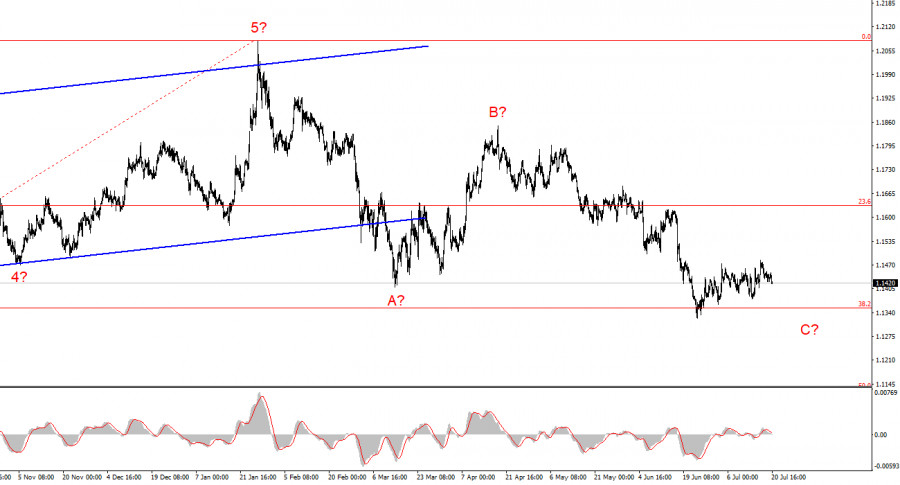
Based on my EUR/USD analysis, I conclude that the pair remains within its broader upward trend segment (shown in the lower chart), while in the shorter term it continues to trade within a downward trend segment. In my opinion, the current environment offers a reasonable opportunity to begin building long positions, although the pair could still decline toward the 1.13 level as part of wave 5 within wave C. Since wave analysis often produces unexpected developments, I would already begin preparing for buying opportunities.
On the higher time frame, an upward trend segment remains visible, followed by the formation of a corrective wave structure. In the near term, wave C is expected to continue developing toward the 1.1352 level, which corresponds to the 38.2% Fibonacci retracement level. Once the A-B-C corrective structure is complete, a new long-term upward trend may begin.
ForexMart is authorized and regulated in various jurisdictions.
(Reg No.23071, IBC 2015) with a registered office at First Floor, SVG Teachers Co-operative Credit Union Limited Uptown Building, Corner of James and Middle Street, Kingstown, Saint Vincent and the Grenadines
Restricted Regions: the United States of America, North Korea, Sudan, Syria and some other regions.











 コンタクトする