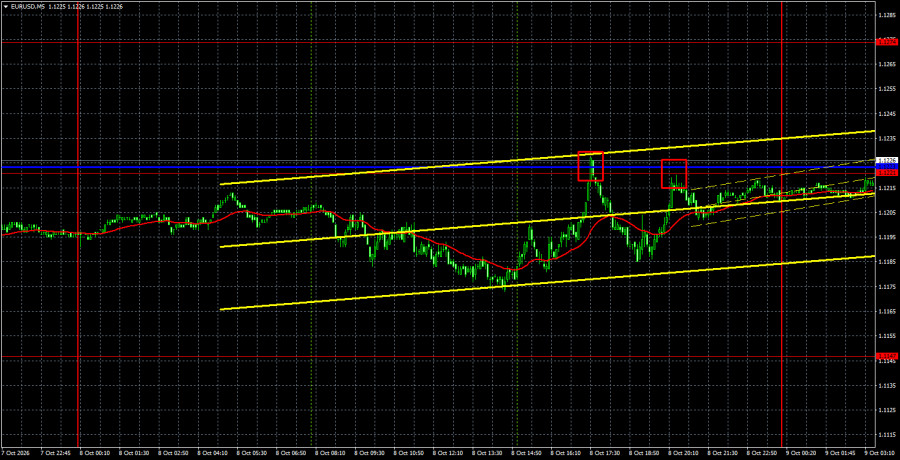
The EUR/USD pair managed a modest lift on Thursday, but it didn't help much. For more than a week the euro has tried with all its might to resist the US dollar's advance, yet it cannot even produce a correction commensurate with the nearly 500-pip decline. Of course the dollar cannot rise forever, but at the moment it is extremely hard to imagine what would make it fall even slightly—even for a correction. We continue to view the current move as illogical, inertial and speculative. The current pause in the decline may be just a pause, not the start of a new uptrend. Although the technical picture on higher timeframes has pointed to the need to resume a global uptrend for about a year now, the market keeps interpreting almost any event in the dollar's favor and ignoring factors that are positive for the euro. Thus, the "foundation/geopolitics/macroeconomics – pricing" link does not work.
Technically, the downtrend remains in place. The market has been buying the dollar for the fifth consecutive week. The trendline remains relevant, and price sits below the Ichimoku lines; hence the pair's fall is fully consistent from a technical standpoint. Expect a euro recovery only after the trendline is overcome.
On the 5-minute TF on Thursday, two sell signals formed as bounces from the 1.1221–1.1225 area. Price declined slightly after those bounces but failed to develop the move. Today, the pair is likely to breach the indicated area and continue a modest downward correction.
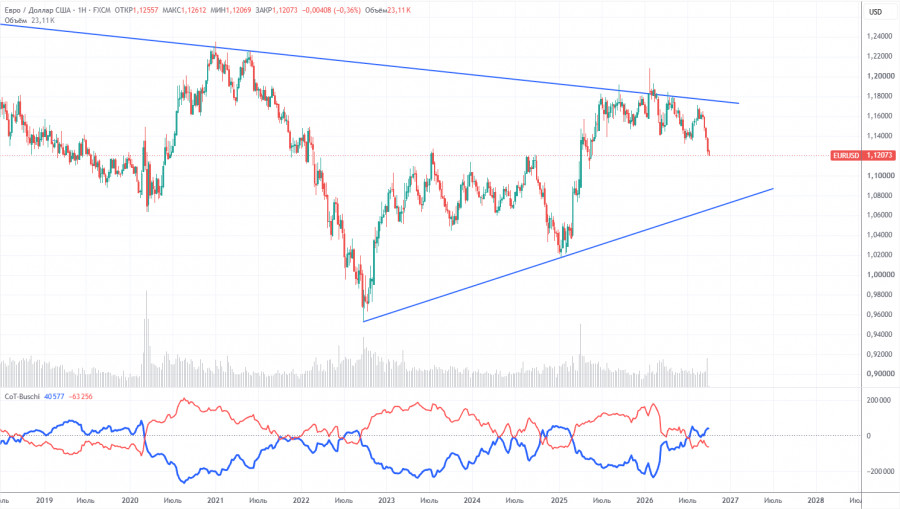
The latest COT report is dated September 29. On the weekly TF chart, non-commercial traders' net position remains "bearish" and fell significantly in 2026 due to geopolitical events. Traders have been shedding the euro in favor of the US dollar over the past six months. Donald Trump's policies have not changed, but the dollar has, for a time, acted as a "reserve currency."
However, we still do not see any fundamental factors that would further strengthen the US currency. The war in the Middle East made the dollar temporarily super-attractive, and the Federal Reserve's monetary stance surprised the dollar for the second time this year. In the long term, the euro could fall even to $1.08 (the trendline), but the uptrend will remain relevant. However, in recent weeks, the market has accounted only for factors that are positive to the dollar and ignored all others.
The arrangement of the red and blue indicator lines points to an approximate parity between bulls and bears. During the last reporting week, longs in the "Non-commercial" group rose by 17,500, while short positions rose by 28,400. Accordingly, the net position for the week decreased by 10,900 contracts.
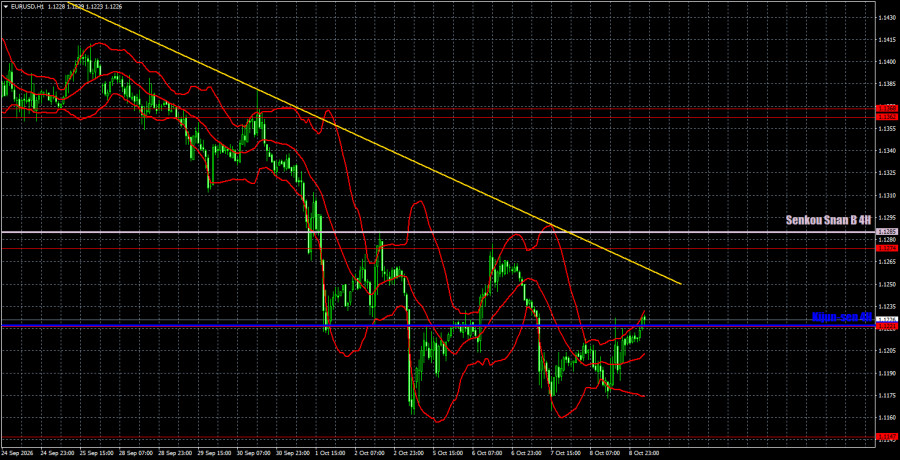
On the hourly timeframe, EUR/USD continues to form a downward trend. The Fed greatly helped drive the downward trend, but that factor is unlikely to explain the dollar's strength several weeks after the meeting. The European Central Bank should have supported the euro, having raised rates twice in 2026, and US labor-market data should have even provoked a dollar collapse. But the market no longer sees factors supporting the euro. Thus the dollar continues to form a strong trend that now depends only on market sentiment.
For October 9 we highlight the following trading levels — 1.1092, 1.1147, 1.1221, 1.1274, 1.1362–1.1368, 1.1461–1.1473, 1.1536–1.1542, 1.1585, 1.1657–1.1665, and also the Senkou Span B line (1.1285) and Kijun-sen (1.1222). The Ichimoku indicator lines may shift during the day, so account for this when determining trading signals. Don't forget to move the Stop Loss to breakeven if the price moves 15 pips in the right direction. This will protect against possible losses if the signal proves false.
On Friday, no major releases are scheduled in the Eurozone, and the US will publish the University of Michigan consumer-sentiment index. We do not expect a market reaction, and today's moves will again be largely technical.
Traders can consider targets for short positions near 1.1147 if the price is rejected today from the 1.1221–1.1222 area. If the trendline is breached, consider targets for long positions: 1.1285 and 1.1362–1.1368.
ForexMart is authorized and regulated in various jurisdictions.
(Reg No.23071, IBC 2015) with a registered office at First Floor, SVG Teachers Co-operative Credit Union Limited Uptown Building, Corner of James and Middle Street, Kingstown, Saint Vincent and the Grenadines
Restricted Regions: the United States of America, North Korea, Sudan, Syria and some other regions.












 コンタクトする