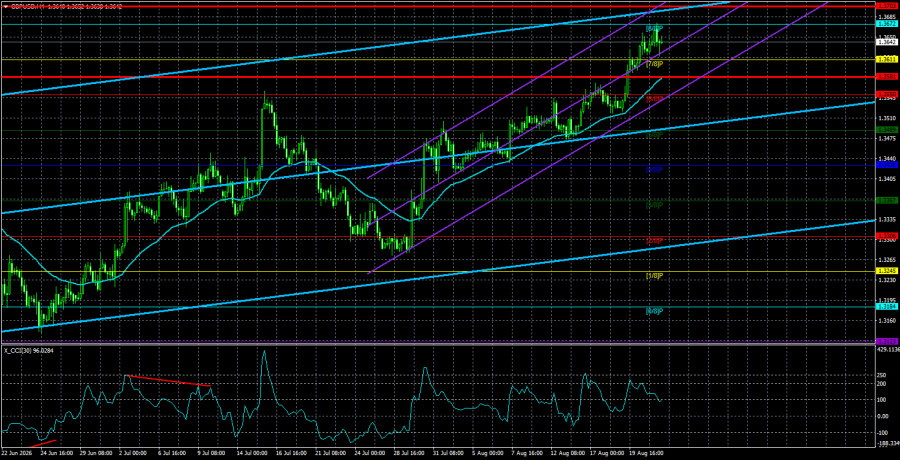
The GBP/USD currency pair also showed confident growth over the past week, primarily thanks to the U.S. Treasury. The decision made by the Treasury was aimed at lowering yields on long-term bonds, but this has not been fully achieved yet. Many experts believe it will not be. However, for the U.S. dollar, this was a significant blow. The key factor is not the increase in long Treasury purchases, but the very act of raising the alarm by the Treasury. The American economy always needs borrowed capital, and naturally, the lower the cost of servicing debt, the better. Currently, the rates on 10-year and 30-year Treasuries have hit their highest levels in nearly 20 years. The burden on the federal budget is growing, and the national debt is rising, even though Donald Trump seemingly promised very different outcomes. But who cares what Trump promised two years ago? Joe Biden is to blame for everything.
However, it should be noted that the U.S. Treasury's decision was not the only factor influencing the dollar's decline. For more than a month, we have observed that the GBP/USD pair is in a long-term sideways channel. As soon as the lower boundary was tested, we began forecasting a rise to the upper boundary. After two months of movement, there are still about 80-100 pips left to reach the upper limit. Should we continue to expect a decline in the British currency? In our opinion, no. Firstly, a flat market is not a life sentence. It will eventually end, even on the weekly timeframe. Secondly, what growth factors remain for the dollar? We asked ourselves this question two months ago when there was a risk that the price would break out of the sideways channel at its lower boundary. Now the situation has worsened even further. At that time, the market believed in a tightening of Federal Reserve monetary policy and anticipated that geopolitics would support the U.S. currency for some time. At the same time, the Treasury had not yet sounded the alarm. Accordingly, the price breaking through the upper boundary of the sideways channel at 1.3150-1.3780 is much more viable.
Regarding the fundamentals of the British pound, it was reported last week that the inflation rate rose to 2.9%, slightly increasing the likelihood of a tightening of monetary policy by the Bank of England, which is not subject to directives from Trump. If inflation continues to rise, the BoE may actually raise the key interest rate. Unlike the Fed, which is being attacked from all sides, inflation in the U.S. is decreasing, the labor market is convulsing once again, and Trump is calling for a reduction in the key rate as the national debt rises. Under such conditions, we believe the Fed will likely sacrifice inflation rather than the economy or the labor market.
Thus, the British pound has everything it needs to continue moving north. And the U.S. dollar has no other path but to fall. Of course, this will not be a one-sided movement. From time to time, the dollar will correct in both the short and long term. And it has been doing just that for the past four years.
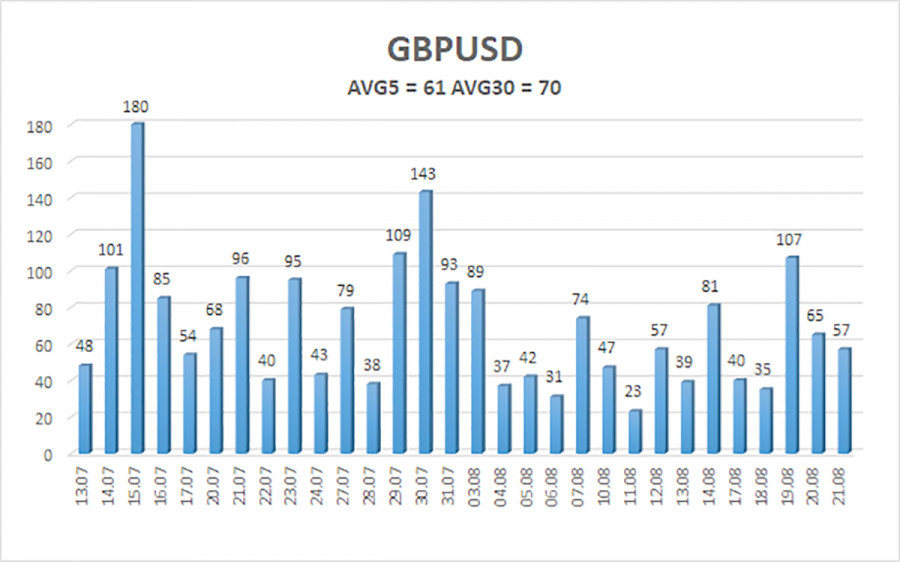
The average volatility of the GBP/USD pair over the past 5 trading days stands at 61 pips. For the GBP/USD pair, this figure is considered "average." On Monday, August 24, we expect movement within the range bounded by levels 1.3581 and 1.3703. The higher linear regression channel has shifted upward, indicating an uptrend. The CCI indicator has entered the overbought area for the third time, once again warning of a potential correction.
S1 – 1.3611
S2 – 1.3550
S3 – 1.3489
R1 – 1.3672
R2 – 1.3733
R3 – 1.3794
The GBP/USD currency pair maintains its upward trend. Trump's policies will continue to exert pressure on the U.S. economy, so we do not expect long-term growth in the U.S. dollar. So far, 2026 has been super-positive for the dollar due to geopolitical factors, but every tale has an end. On the weekly timeframe, a flat market persists between 1.3150 and 1.3780, within the framework of a four-year upward trend, allowing for continued growth of the British currency in the medium term. Long positions with targets at 1.3672 and 1.3703 can be considered when the price is above the moving average. If the price is below the moving average line, it allows for short positions with targets at 1.3489 and 1.3428.
SZYBKIE LINKI
ForexMart is authorized and regulated in various jurisdictions.
(Reg No.23071, IBC 2015) with a registered office at First Floor, SVG Teachers Co-operative Credit Union Limited Uptown Building, Corner of James and Middle Street, Kingstown, Saint Vincent and the Grenadines
Restricted Regions: the United States of America, North Korea, Sudan, Syria and some other regions.











 Skontaktuj się z ForexMart