The test of 158.02 occurred as the MACD indicator began moving up from zero, prompting dollar buying and resulting in losses. A similar story played out with short positions
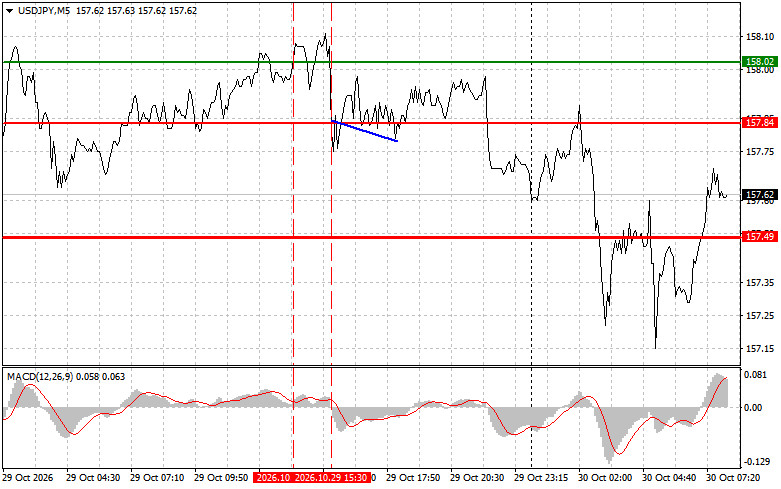
The test of 158.02 occurred as the MACD indicator began moving up from zero, prompting dollar buying and resulting in losses. A similar story played out with short positions at 157.84, where the pair did not go on to decline sharply.
Today the yen has strengthened slightly versus the dollar after the Bank of Japan decision. The central bank kept the rate at 1.25% as economists expected, with the council vote splitting 8–1. By comparison, at the September meeting that raised the rate to 1.25%, the vote was 7–2 — so unanimity has increased. The key statement was that core inflation has reached the 2% target for the first time. That acknowledgment helps the BOJ assess how much more tightening is required before stimulus is no longer necessary.
Japanese data this morning complemented the picture. Tokyo core CPI for October came in at 2.6% (forecast 2.6%, prior 2.7%) — in line with expectations, though the pace edged down slightly. Industrial production rose 2.2% month-on-month in September, up from a 1.2% forecast and after a -2.4% print in August; the rebound was noticeably stronger than expected. Targeted inflation and the rebound in production give the BOJ more confidence that domestic demand is gradually strengthening.
The external backdrop also worked in favor of the yen. On Friday, global markets saw increased demand for safe-haven assets: tech equities fell, and oil rose. The yen is again showing signs of returning to a safe-haven role after many years, when large rate differentials and sizeable overseas Japanese investments tended to dominate currency demand during periods of instability.
For intraday strategy, I will mainly rely on Scenarios No. 1 and No. 2.
Scenario No. 1: I plan to buy USD/JPY today as it moves into the entry area around 157.75 (green line on the chart), targeting 158.07 (the thicker green line on the chart). Around 158.07, I intend to exit long positions and open short positions in the opposite direction (expecting a 30–35-pip reversal from that level). It's best to return to buying the pair on corrections and significant pullbacks. Important! Before buying, make sure the MACD indicator is above zero and is just beginning to turn up from it.
Scenario No. 2: I also plan to buy USD/JPY today if the price tests 157.51 twice in succession while the MACD is in the oversold area. That would limit the pair's downside potential and trigger a reversal upward. One can expect a rise to the opposite levels of 157.75 and 158.07.
Scenario No. 1: I plan to sell USD/JPY today only after 157.51 is breached to the downside (red line on the chart), which would lead to a rapid decline in the pair. Sellers' key target is 157.16, where I intend to exit shorts and immediately open longs in the opposite direction (expecting a 20–25-pip reversal from that level). Sellers can return at any time — often a hint from the central bank is enough. Important! Before selling, make sure the MACD indicator is below zero and is just beginning to turn down from it.
Scenario No. 2: I also plan to sell USD/JPY today if the price tests 157.75 twice in succession while the MACD is in the overbought area. That would limit the pair's upside potential and bring about a downward reversal. One can expect a decline to the opposite levels of 157.51 and 157.16.
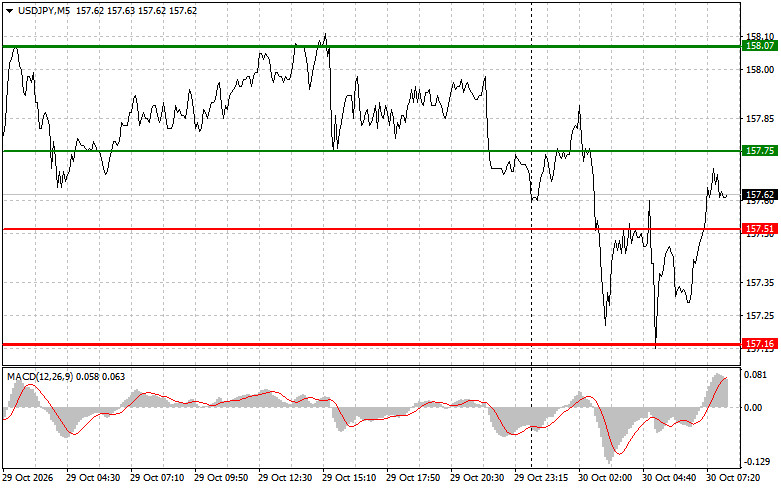
Thin green line — entry price where you can buy the instrument.
Thick green line — approximate price where you can place Take Profit or manually lock in profits, because further upside above this level is unlikely.
Thin red line — entry price where you can sell the instrument.
Thick red line — approximate price where you can place Take Profit or manually lock in profits, because further downside below this level is unlikely.
MACD indicator. When entering the market, it's important to consider overbought and oversold zones.
Important. Novice Forex traders must be very cautious when deciding to enter the market. It is best to stay out before major fundamental reports to avoid getting caught in sharp price swings. If you decide to trade during news releases, always place stop orders to minimize losses. Without stop orders, you can quickly lose your entire deposit, especially if you don't use money management and trade large volumes.
Remember: successful trading requires a clear trading plan, like the example above. Spontaneous trade decisions based solely on the immediate market situation are, by definition, a losing strategy for an intraday trader.

SZYBKIE LINKI
ForexMart is authorized and regulated in various jurisdictions.
(Reg No.23071, IBC 2015) with a registered office at First Floor, SVG Teachers Co-operative Credit Union Limited Uptown Building, Corner of James and Middle Street, Kingstown, Saint Vincent and the Grenadines
Restricted Regions: the United States of America, North Korea, Sudan, Syria and some other regions.







 Skontaktuj się z ForexMart