On Tuesday, the EUR/USD pair continued to decline after consolidating below the 1.1081–1.1086 support level, heading toward the next support level at 1.0939–1.0944. At present, there are no signs that
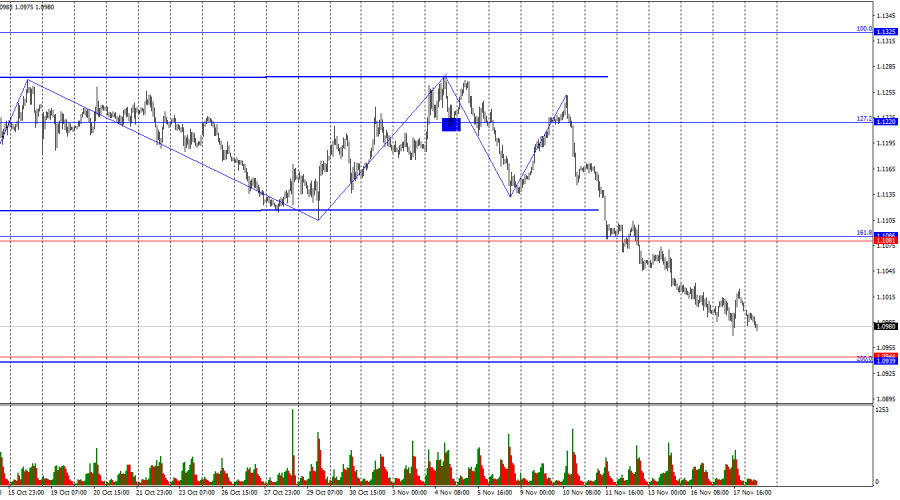
On Tuesday, the EUR/USD pair continued to decline after consolidating below the 1.1081–1.1086 support level, heading toward the next support level at 1.0939–1.0944. At present, there are no signs that the decline is coming to an end. There can be endless debate about whether the euro's sharp decline in recent weeks was justified, but the technical picture on the charts explains much of what is happening. A rebound from the 1.0939–1.0944 support level would give traders grounds to expect a recovery.
The wave structure on the hourly chart remains bearish. The latest completed upward wave failed to break the previous peak, while the new downward wave broke below the previous low. Following the September FOMC meeting, traders have been expecting at least one more monetary policy tightening before the end of the year and are allowing for two additional moves next year. This factor continues to support the US dollar, while economic data from the United States only increase the likelihood of the most hawkish scenario materializing.
The news background on Tuesday was mixed. On the one hand, the ZEW Economic Sentiment Index readings for the European Union and Germany exceeded traders' expectations, while the US industrial production report came in weaker than forecast. On the other hand, further comments from Fed policymakers once again raised market expectations for FOMC monetary policy tightening. The market is now pricing in three consecutive interest rate hikes in December, January, and March with a high degree of probability. There are doubts about a March hike, but the faster inflation rises, the fewer doubts remain. However, it would be premature to draw conclusions, as the annual inflation rate for October is not yet known. It is reasonable to assume that if monthly inflation increased, annual inflation also rose. But by how much? Therefore, conclusions should be based solely on the November report. At present, there are no clear grounds for expecting the pair to continue declining, as the market has already priced in all the most hawkish scenarios.
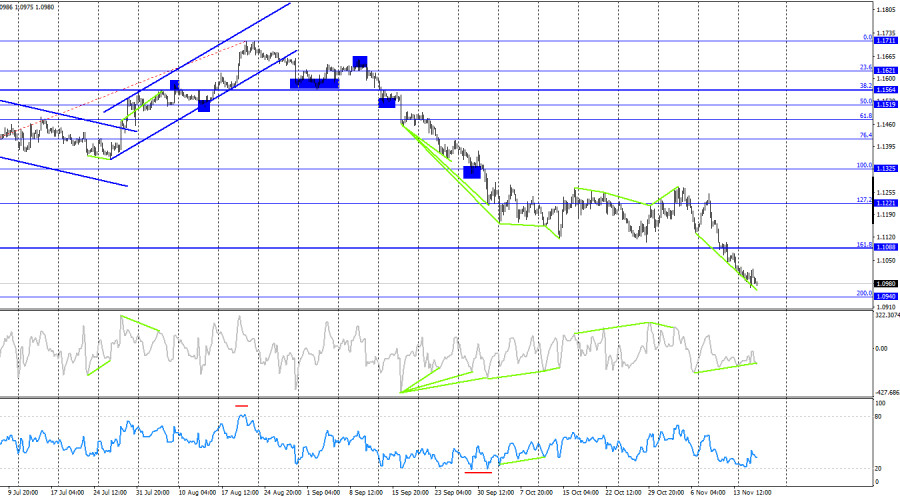
On the 4-hour chart, the pair has made another reversal in favor of the US dollar and consolidated below the 161.8% Fibonacci level at 1.1088. Thus, the decline may continue toward the next corrective level of 200.0% at 1.0940. A rebound from 1.0940 would allow traders to expect a recovery toward 1.1088. A bullish divergence is developing on the CCI indicator, which could bring the euro's decline to a halt.
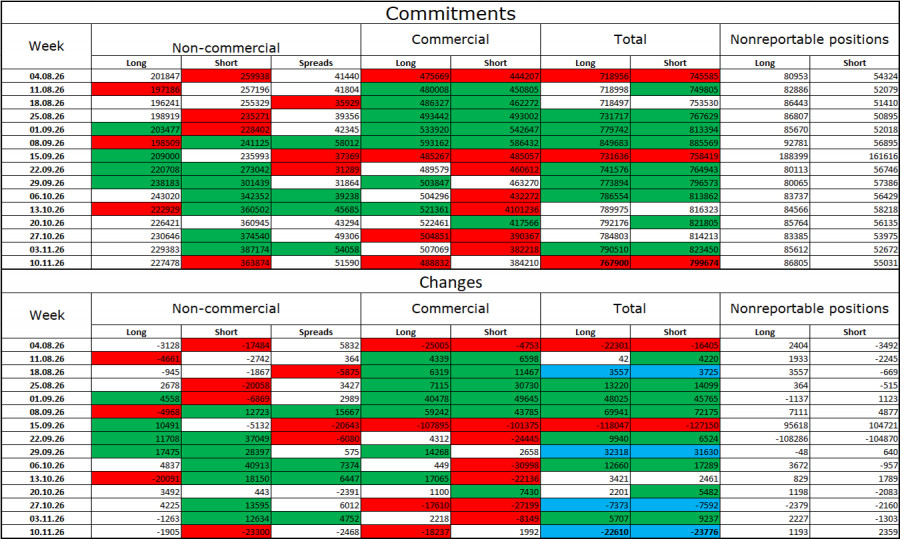
During the latest reporting week, professional traders closed 1,905 Long positions and 23,300 Short positions. Speculators currently hold a total of 227,000 Long positions and 364,000 Short positions. Bears remain in control, and the euro continues to be sold more often than it is bought. This is explained by the difficult geopolitical situation in the Middle East and the Fed's willingness to continue tightening monetary policy. The market believes that the Fed will keep raising rates for as long as necessary.
Overall, over the longer term, major market participants continue to show considerable interest in the euro. Events of various kinds around the world—which have been abundant in recent years—undoubtedly affect investor sentiment and put pressure on risk-sensitive currencies. Moreover, 2026 could set a record for the number of events that could not have been anticipated in advance. For now, the euro is waiting for its opportunity.
The November 18 economic calendar contains three events, of which Christine Lagarde's speech is the only one worth highlighting. The impact of economic news on market sentiment on Wednesday may be limited.
Long positions may be considered if the pair rebounds from the 1.0939–1.0944 level on the hourly chart, with a target of 1.1081. Short positions could have been opened after the pair consolidated below the 1.1081–1.1086 level on the hourly chart, targeting 1.0939–1.0944. These positions may now be closed, as the target is close and the number of factors supporting further dollar gains is decreasing.
The Fibonacci grids are drawn from 1.1325 to 1.1712 on both the hourly and 4-hour charts.

SZYBKIE LINKI
ForexMart is authorized and regulated in various jurisdictions.
(Reg No.23071, IBC 2015) with a registered office at First Floor, SVG Teachers Co-operative Credit Union Limited Uptown Building, Corner of James and Middle Street, Kingstown, Saint Vincent and the Grenadines
Restricted Regions: the United States of America, North Korea, Sudan, Syria and some other regions.







 Skontaktuj się z ForexMart