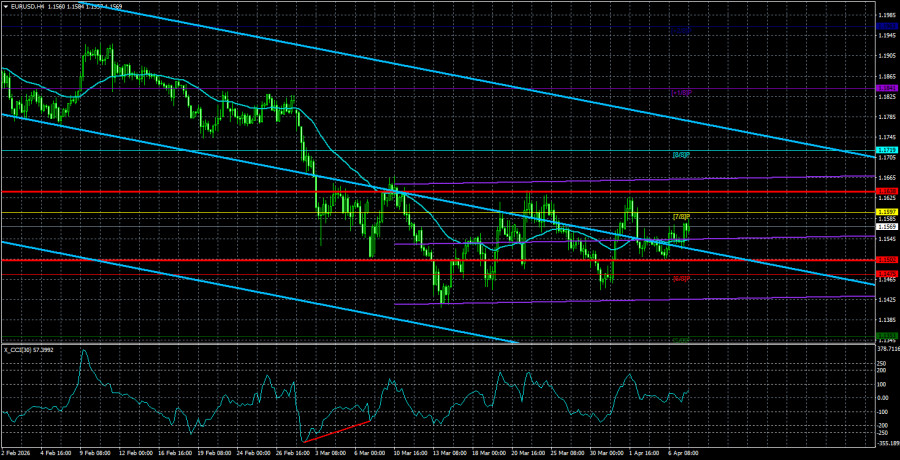
The EUR/USD currency pair continued to trade very sluggishly on Tuesday, ultimately settling into a sideways channel. On the 4-hour time frame, it is now clear that the price has traded primarily between 1.1450 and 1.1620 over the past few weeks. Thus, we are not just looking at a semblance of a flat market but a genuine flat. However, this is a very rare type of flat, where all movements leading to its formation are indeed caused by specific events.
Typically, a flat forms not because every subsequent piece of news contradicts the previous ones, forcing the price to jump up and down. A flat forms when the market needs a pause to distribute or accumulate new positions. Therefore, the price moves sideways, and during this time, the market either ignores fundamental and macroeconomic events or reacts to them only minimally. Currently, the situation is the opposite. Each subsequent geopolitical event contradicts the previous one, causing the price to fluctuate. The macroeconomic and fundamental backdrop is being ignored by the market.
The key question now is whether the EUR/USD pair has reached its "bottom." Many experts are discussing a "bottom" in the market, but they also acknowledge that the pair may continue to decline if the situation in the Middle East worsens. The general consensus in the current context is as follows: in the long term, the euro is expected to rise due to the contradictory and destructive policies of Trump; in the short term, the dollar could strengthen due to complicated geopolitical issues; if the geopolitical landscape does not change drastically in the near future, flat trends will persist.
Therefore, traders are left to wait for new developments in the Middle East. It seems they won't have to wait long. Just yesterday, Iran attacked a petrochemical facility in Jubail, Saudi Arabia. Tonight, Donald Trump may order another bombing of Iran if the Strait of Hormuz is not unblocked. Interestingly, in recent days, some vessels have passed through the Strait of Hormuz, but the terms of the agreement with Tehran remain unknown. Thus, the situation around Hormuz is officially improving, though a complete unblocking is still not on the table.
Additionally, it has been reported that Tehran has provided Washington with a list of 10 points necessary to resolve all disputes. Specifically, Iran is demanding security guarantees, a cessation of strikes, reparations for destroyed infrastructure, and a complete lifting of sanctions. Does anyone believe that Trump will meet these conditions? Moreover, Iran now wants to charge $2 million from each tanker passing through the Strait of Hormuz... In our view, a new wave of conflict in the Middle East is inevitable.
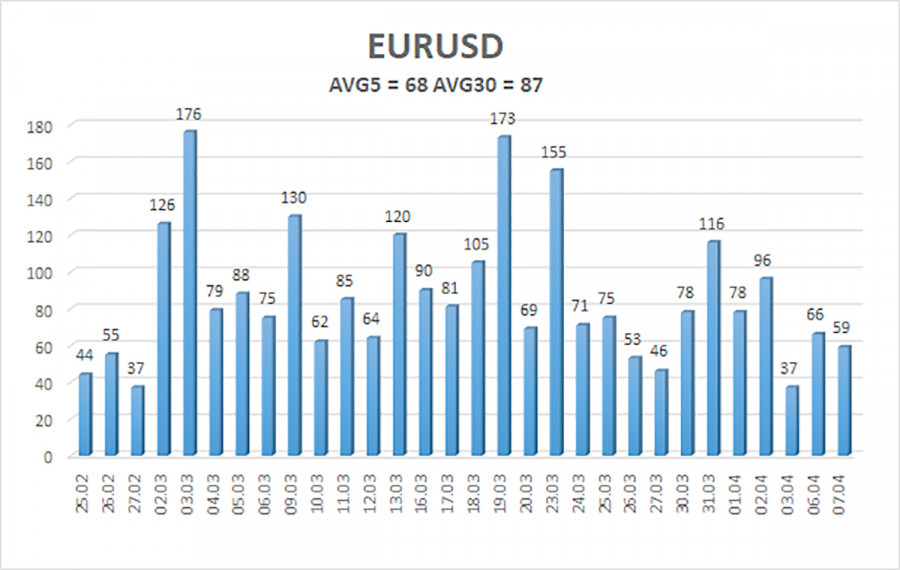
The average volatility of the EUR/USD currency pair over the last five trading days as of April 8 is 68 pips, which is considered "average." We expect the pair to trade between 1.1502 and 1.1638 on Wednesday. The upper channel of the linear regression has turned down, indicating a shift in trend. The CCI indicator has entered the oversold area and formed a "bullish" divergence, which once again warns of the completion of the downward trend.
The EUR/USD pair remains in a downward trend, driven by geopolitical factors. The global fundamental backdrop for the dollar remains extremely negative; however, for more than a month, the market has been focusing solely on geopolitics, making all other factors practically irrelevant. With the price located below the moving average, short positions can be considered targeting 1.1475 and 1.1353. Above the moving average line, long positions are relevant with targets at 1.1627 and 1.1719. For a stronger upward movement, the geopolitical backdrop needs to start improving. For the last three weeks, the market has traded flat between 1.1450 and 1.1620.
LINKS RÁPIDOS
ForexMart is authorized and regulated in various jurisdictions.
(Reg No.23071, IBC 2015) with a registered office at First Floor, SVG Teachers Co-operative Credit Union Limited Uptown Building, Corner of James and Middle Street, Kingstown, Saint Vincent and the Grenadines
Restricted Regions: the United States of America, North Korea, Sudan, Syria and some other regions.






 Contate-nos