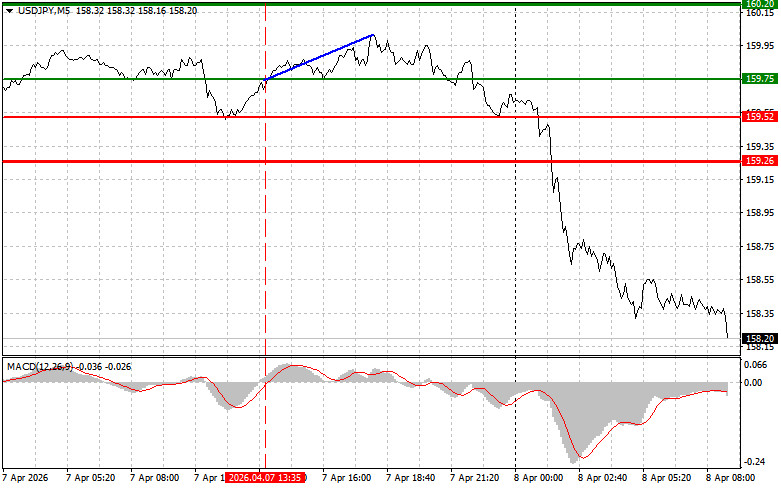
The price test at 159.75 coincided with a moment when the MACD indicator was just beginning to move above the zero mark, confirming the correct entry point for buying the dollar. As a result, the pair rose by 25 pips.
The yen appreciated after Donald Trump abandoned his previous threats against Iran and expressed readiness for a truce. Earlier concerns about a possible escalation of the conflict, which had supported demand for the dollar as a safe-haven asset, were replaced by a more cautious optimism. Today's positive data on wage changes and the current account balance in Japan led to further declines in USD/JPY. The drop in the USD/JPY exchange rate reflects not only the fundamental improvements in the Japanese economy but also a shift in global investment flows. Investors who previously sought refuge in the dollar amid geopolitical tensions are now ready to consider assets in regions perceived as lower risk. This contributes to capital outflows from the U.S. and the redirection of funds to other markets that they view as more promising.
In the long run, the dynamics of the USD/JPY pair will depend on many factors. Will Trump's rhetoric regarding Iran remain cautious? What new economic signals will emerge from Japan and the U.S.? And how will the overall geopolitical situation evolve? All of these factors will shape the future landscape. However, for the moment, the yen has several grounds for further strengthening.
As for the intraday strategy, I will focus more on implementing Scenarios #1 and #2.
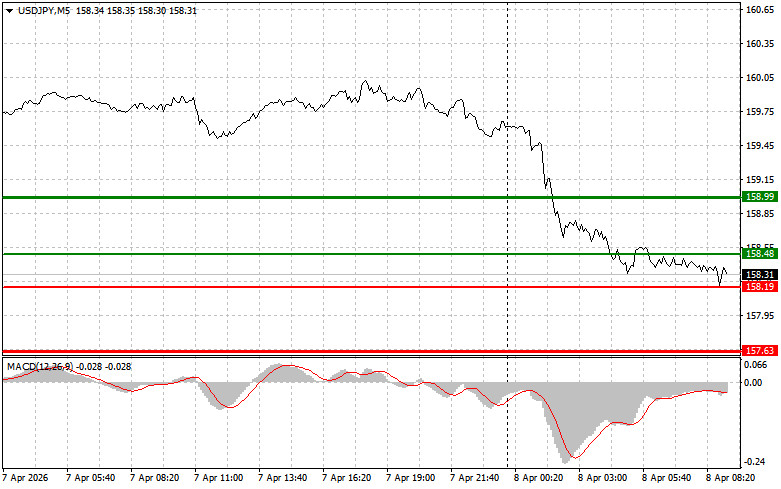
Scenario #1: I plan to buy USD/JPY today at an entry point around 158.48 (green line on the chart), with a target for growth to 158.99 (thicker green line on the chart). At 158.99, I plan to exit the long positions and immediately sell in the opposite direction, anticipating a movement of 30-35 pips from the entry point. It's best to return to buying the pair during corrections and serious pullbacks in USD/JPY. Important! Before buying, ensure that the MACD indicator is above the zero mark and just beginning to rise from it.
Scenario #2: I also plan to buy USD/JPY today in the event of two consecutive tests of the price 158.19 when the MACD indicator is in the oversold area. This will limit the pair's downside potential and lead to an upward market reversal. A rise to resistance levels of 158.48 and 158.99 can be expected.
Scenario #1: I plan to sell USD/JPY today only after it breaks the 158.19 level (red line on the chart), which will trigger a rapid decline in the pair. The key target for sellers will be the level of 159.38, where I plan to exit the short positions and immediately open longs in the opposite direction (anticipating a movement of 20-25 pips back from the level). It's better to sell as high as possible. Important! Before selling, ensure that the MACD indicator is below the zero mark and just beginning to decline from it.
Scenario #2: I also plan to sell USD/JPY today in the event of two consecutive tests of the price 158.48 when the MACD indicator is in the overbought area. This will limit the pair's upside potential and lead to a downward market reversal. A decline to support levels of 158.19 and 157.63 can be expected.
Important: Beginner traders in the Forex market need to be very cautious when making entry decisions. It is best to be out of the market before important fundamental reports are released to avoid being caught in sharp price fluctuations. If you choose to trade during news releases, always set stop orders to minimize losses. Without setting stop orders, you can quickly lose your entire deposit, especially if you do not use money management and trade large volumes.
And remember, for successful trading, it is essential to have a clear trading plan, like the one presented above. Spontaneous trading decisions based on the current market situation are inherently a losing strategy for intraday traders.
LINKS RÁPIDOS
ForexMart is authorized and regulated in various jurisdictions.
(Reg No.23071, IBC 2015) with a registered office at First Floor, SVG Teachers Co-operative Credit Union Limited Uptown Building, Corner of James and Middle Street, Kingstown, Saint Vincent and the Grenadines
Restricted Regions: the United States of America, North Korea, Sudan, Syria and some other regions.











 Contate-nos