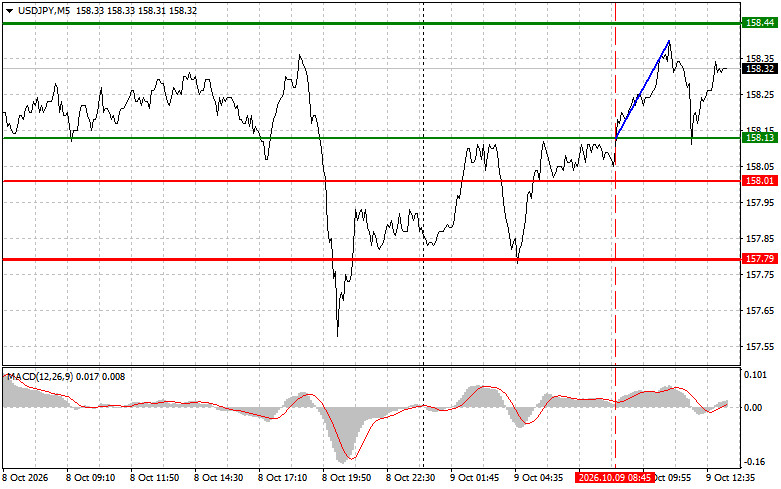
The test of the 158.13 price level occurred when the MACD indicator had just begun moving upward from the zero line, confirming the correct entry point for buying the US dollar. As a result, the pair rose by more than 20 points.
Japan delivered mixed signals to the market. Household spending fell by 3.1% in August, but this was better than the forecast decline of 3.5% and significantly better than the previous reading of 3.6%. Consumption continues to contract, although the pace of decline is slowing. September machinery orders painted a less encouraging picture. The figure fell to 60.4% from 64.7% the previous month, indicating a cooling in investment demand.
In my view, the overall picture for the yen is neutral. Domestic demand appears weak, leaving the national currency with few domestic factors to support a sustained rise. As a result, the main market moves will come from external factors.
The next focus will be the University of Michigan Consumer Sentiment Index for October, forecast at 47.6, along with inflation expectations. In the evening, FOMC member Susan Collins is scheduled to speak. A weak US reading could support the yen, as happened yesterday when the dollar weakened following Trump's statement on Iran.
As for the intraday strategy, greater emphasis will be placed on implementing Scenarios No. 1 and No. 2.
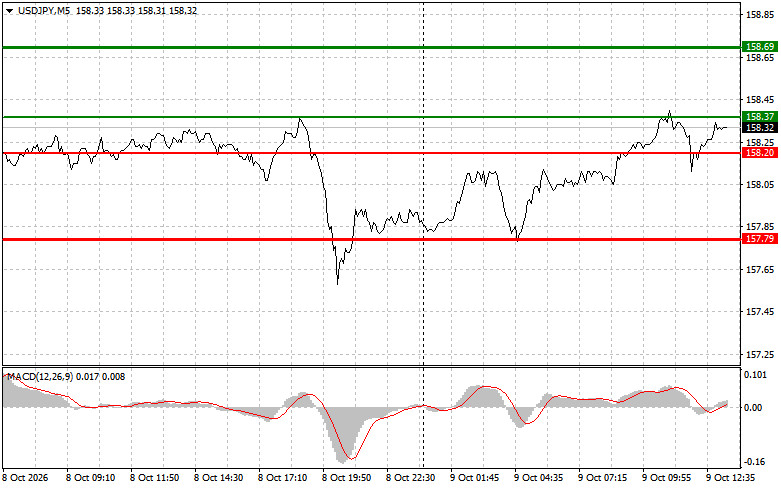
Scenario No. 1: The plan is to buy USD/JPY today when the price reaches the entry point around 158.37 (the green line on the chart), targeting a rise to 158.69 (the thicker green line on the chart). Around 158.69, the plan is to close long positions and open short positions in the opposite direction, targeting a move of 30–35 points in the opposite direction from that level. The pair could rise today, but the upward potential appears rather limited. Important! Before buying, make sure that the MACD indicator is above the zero line and has only just begun rising from it.
Scenario No. 2: The plan is also to buy USD/JPY today if the price tests the 158.20 level twice consecutively while the MACD indicator is in the oversold zone. This would limit the pair's downward potential and trigger an upward market reversal. The pair could rise toward the opposite levels of 158.37 and 158.69.
Scenario No. 1: The plan is to sell USD/JPY today after the price breaks below the 158.20 level (the red line on the chart), which could trigger a rapid decline in the pair. The sellers' key target will be 157.79, where the plan is to close short positions and immediately open long positions in the opposite direction, targeting a move of 20–25 points in the opposite direction from that level. Selling pressure on the pair could return today if the central bank intervenes. Important! Before selling, make sure that the MACD indicator is below the zero line and has only just begun declining from it.
Scenario No. 2: The plan is also to sell USD/JPY today if the price tests the 158.37 level twice consecutively while the MACD indicator is in the overbought zone. This would limit the pair's upward potential and trigger a downward market reversal. The pair could decline toward the lower levels of 158.20 and 157.79.
Important: Beginner Forex traders should exercise extreme caution when making market entry decisions. Before the release of major fundamental reports, it is generally best to stay out of the market to avoid sudden exchange-rate fluctuations. If trading during news releases, always place stop-loss orders to minimize losses. Without stop-loss orders, the entire trading account can be depleted very quickly, especially when risk management rules are ignored and large position sizes are used.
Remember that successful trading requires a clear trading plan, such as the example presented above. Making spontaneous trading decisions based on current market conditions is a losing strategy for an intraday trader from the outset.

LINKS RÁPIDOS
ForexMart is authorized and regulated in various jurisdictions.
(Reg No.23071, IBC 2015) with a registered office at First Floor, SVG Teachers Co-operative Credit Union Limited Uptown Building, Corner of James and Middle Street, Kingstown, Saint Vincent and the Grenadines
Restricted Regions: the United States of America, North Korea, Sudan, Syria and some other regions.











 Contate-nos