VUG nebo IWF? Pro růstové investory má Vanguard výhodu
Investice do ETF fondů zaměřených na růstové akcie je osvědčeným způsobem, jak si zajistit expozici vůči nejdynamičtěji se rozvíjejícím firmám. Mezi nejoblíbenější produkty v této kategorii patří iShares Russell 1000 Growth ETF (IWF) a Vanguard Growth ETF (VUG). Na první pohled se může zdát, že oba fondy nabízejí téměř totéž. Při bližším pohledu však vyjde najevo několik zásadních rozdílů, které mohou rozhodnout o tom, který fond je pro vás ten pravý.
 $83.49
Oba fondy drží převážně technologické giganty, jako jsou Microsoft, Apple, Nvidia, Amazon nebo Alphabet. V deset největších pozicích fondů je značný překryv a tvoří téměř 60 % celkových aktiv. Rozdíl je však v tom, že IWF zahrnuje také firmy se střední kapitalizací, zatímco VUG se zaměřuje výhradně na large-cap akcie. Díky tomu má IWF téměř 400 podílů, zatímco VUG jen kolem 160.
V praxi to znamená, že VUG se více koncentruje na silné hráče, což může pomoci v obdobích, kdy dominují právě velké technologické firmy. Tato koncentrace může zvyšovat výnos, ale zároveň i volatilitu. Pro investora, který cílí na čistý výnosový potenciál největších růstových jmen, může být právě tato expozice výhodná.
| IWF | VUG |
|---|---|
| Microsoft (11.7%) | Microsoft (11.3%) |
| Nvidia (11.1%) | Nvidia (10.3%) |
| Apple (9.5%) | Apple (10.1%) |
| Amazon (6.6%) | Amazon (6.3%) |
| Meta Platforms (4.6%) | Meta Platforms (4.4%) |
| Broadcom (3.8%) | Broadcom (4%) |
| Alphabet Class A (3.4%) | Tesla (3.3%) |
| Tesla (3.1%) | Alphabet Class A (3.3%) |
| Alphabet Class C (2.8%) | Alphabet Class C (2.6%) |
| Eli Lilly (2.2%) | Eli Lilly (2.2%) |
Jedním z největších rozdílů mezi těmito dvěma ETF fondy je nákladovost. Zatímco IWF má roční nákladový poměr 0,19 %, fond VUG účtuje jen 0,04 %. Tento rozdíl může být na první pohled zanedbatelný, ale v dlouhodobém horizontu se významně promítne do čistého výnosu.
Příklad: při investici 10 000 USD zaplatíte u IWF ročně 19 dolarů, zatímco u VUG pouze 4 dolary. Rozdíl 15 dolarů ročně se sčítá a v horizontu deseti i více let ovlivní konečný výnos stovkami až tisíci dolarů. Vzhledem k tomu, že výnosy fondů jsou v mnoha obdobích srovnatelné, dává nižší nákladová struktura VUG investorovi lepší výchozí pozici.
Při pohledu na výkonnost obou fondů v různých časových rámcích vychází VUG ve většině případů jako výnosově silnější alternativa. Za poslední tři roky vykázal fond VUG průměrný roční výnos 19,9 %, zatímco IWF „pouze“ 9,9 %. I za období 10 let měl Vanguard lehce navrch.
Tento rozdíl nelze přičítat pouze výběru akcií, ale i strukturálním výhodám, které VUG nabízí – jako je nízká nákladovost a zaměření na lídry trhu. I když pětileté výnosy jsou naopak vyšší u IWF, dlouhodobější data hovoří ve prospěch VUG. A to i přesto, že fond Vanguard vznikl o čtyři roky později než jeho konkurent z dílny iShares.
| ETF | 1letý | 3letý | 5letý | 10letý | Od vzniku fondu |
|---|---|---|---|---|---|
| IWF | 7.6% | 9.9% | 19.9% | 14.9% | 7.4% |
| VUG | 18.2% | 19.9% | 17.1% | 15.3% | 11.5% |
Investice do růstových ETF má své místo v portfoliích investorů, kteří chtějí v dlouhodobém horizontu maximalizovat výnosy. A i když je IWF stále považován za kvalitní nástroj pro tuto strategii, Vanguard Growth ETF se zdá být ještě lepší volbou. Nabízí téměř stejnou expozici vůči největším růstovým firmám, ale s nižšími náklady a často vyšší historickou výkonností.
Rozdíly nejsou dramatické, ale v investování rozhodují i malé rozdíly kumulované v čase. Proto, pokud chcete vystavit své portfolio růstovým lídrům amerického trhu a zároveň se vyhnout zbytečným nákladům, VUG je konzistentně lepší volba.
The GBP/USD currency pair continued its upward movement on Monday, resuming the trend on the previous Friday. Overall, we believe that without a new and serious escalation of the geopolitical conflict in the Middle East, the dollar has little to rely on. In recent months, we have consistently pointed out that the dollar has one trump card, but that card has an expiration date. Geopolitics indeed triggered a two-month rise in the U.S. dollar, as investors fled the burning Middle East. Everyone was protecting their assets, which led to the rise of the American dollar, which, in some situations, can still be seen as a "safe haven."
However, two months have passed, and the market has begun to recall all the reasons the U.S. dollar fell throughout 2025 and into the beginning of 2026. The war in the Middle East is currently frozen, with the Strait of Hormuz being blocked for the third time. Consequently, markets have quickly adapted to the new energy and geopolitical reality, leaving the dollar without a reason to grow. Thus, for the fourth consecutive week, the market has been actively selling the U.S. currency.
Moreover, the market cannot ignore that energy prices are at least 1.5 times higher and may continue their ascent into the stratosphere in 2026. The sole culprit for this is Donald Trump. His domestic and trade policies led to the situation in 2025, where only the lazy did not sell the dollar. In 2026, Trump demonstrated to the world that his foreign policy is as destructive as his trade and domestic policies. Traders have simply no choice but to sell the troubled U.S. dollar, as there is nothing safe about it anymore. The U.S. economy is slowing, the energy crisis is not sparing America (even with complete energy independence), the U.S. labor market remains in turmoil, and Trump's policies remain the main reason foreign investors and traders often avoid dealing with the U.S.
Therefore, in the current circumstances, it is unnecessary to possess analytical talent to predict the further decline of the U.S. dollar. To be honest, we did not expect its growth in February-March, but neither could a full-scale war in the Middle East have been predicted. If it weren't for the war with Iran, the dollar would likely have already broken its four-year lows established earlier this year. Thus, thanks to the war, the dollar managed to slightly improve its position, but fundamentally, nothing has changed for it. It still lacks any trump cards to encourage traders and investors to buy it. Moreover, Trump continues to believe that the cheaper the dollar is, the more goods, services, and energy resources the US will sell abroad. Therefore, it is clear that no one in the White House is worried about the fall of the American currency, nor will anyone be attempting to save it.
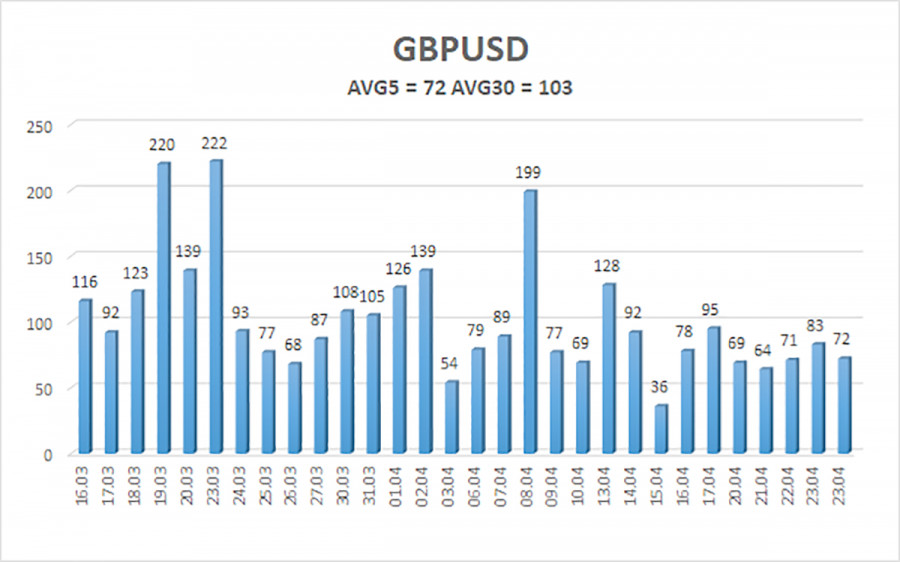
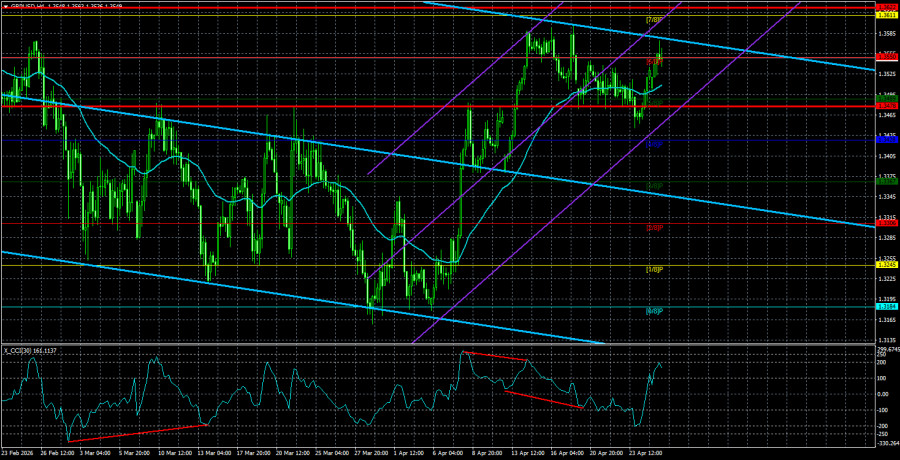
The average volatility of the GBP/USD pair over the last five trading days is 72 pips, which is considered "average" for this currency pair. On Tuesday, April 28, we expect the pair to trade within a range bounded by 1.3478 and 1.3622. The upper channel of the linear regression is directed downward, indicating a bearish trend. The CCI indicator has entered the overbought territory and has formed a "bearish" divergence, which provided a warning about a potential downward pullback in advance.
The GBP/USD currency pair continues its recovery after two "months of geopolitics." Trump's policies will continue to put pressure on the U.S. economy, so we do not expect the U.S. dollar to grow in 2026. Therefore, long positions with a target of 1.3916 and above remain relevant as long as the price is above the moving average. If the price is below the moving average line, short positions can be considered with targets of 1.3478 and 1.3428 based on technical grounds. In recent weeks, the British currency has recovered, while the geopolitical factor has lost its influence on the market.
Linear regression channels help to define the current trend. If both are directed in the same way, it means the trend is currently strong;
The moving average line (settings 20,0, smoothed) determines the short-term trend and the direction in which trading should currently be conducted;
Murray levels are target levels for movements and corrections;
Volatility levels (red lines) indicate the probable price channel in which the pair will operate over the next day, based on current volatility readings;
The CCI indicator – its entrance into the oversold area (below -250) or the overbought area (above +250) indicates that a trend reversal in the opposite direction may be approaching.
TAUTAN CEPAT
ForexMart is authorized and regulated in various jurisdictions.
(Reg No.23071, IBC 2015) with a registered office at First Floor, SVG Teachers Co-operative Credit Union Limited Uptown Building, Corner of James and Middle Street, Kingstown, Saint Vincent and the Grenadines
Restricted Regions: the United States of America, North Korea, Sudan, Syria and some other regions.










 Hubungi kami