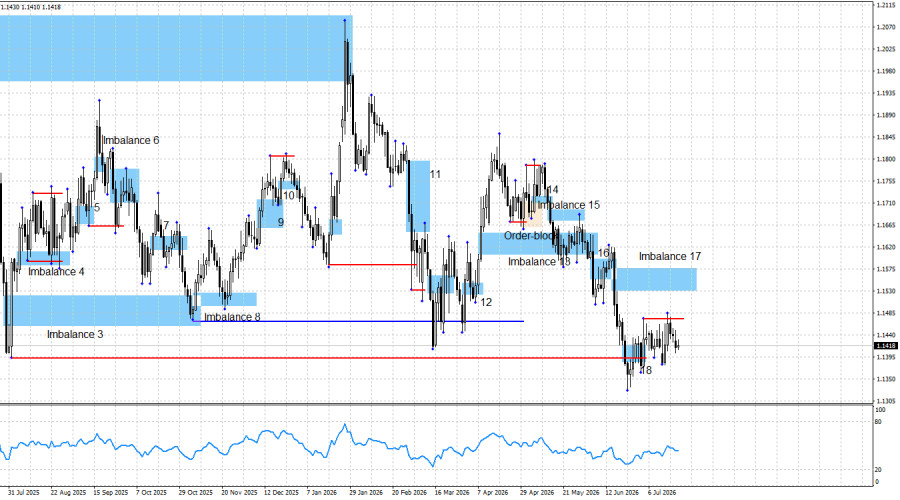
The EUR/USD pair remains within the local bearish impulse that began on April 17, and over the past three weeks the bulls have managed only to push the bears back slightly. Although buyers have attempted to regain control, their advance has lacked conviction. In my view, the euro is currently much closer to another decline than to an extension of its modest recovery. Over the past few weeks, bullish traders have demonstrated little strength. The new trading week began with another decline in the euro, albeit a limited one. The latest liquidity sweep points to a high probability of further downside in EUR/USD. It is difficult to estimate how deep or prolonged the next decline may be, but the bears have one clear downward target—the most recent swing low at 1.1325. Liquidity could also be swept below that low, providing the bulls with a second opportunity to regain the initiative. As for the fundamental backdrop, I still see little justification for the bears to remain so dominant. Geopolitical developments have once again disappointed expectations, but this is unlikely to be the decisive factor for traders, especially since the temporary ceasefire and the reopening of the Strait of Hormuz attracted little market attention. Therefore, I believe the bears may still squeeze some additional downside from the market, but they will not be able to rely on momentum alone indefinitely.
It is also worth recalling that the latest U.S. labor market data was relatively weak, while the inflation report pointed to further disinflation. Job creation remains subdued. Over the past three months, the economy has created roughly 100,000 fewer jobs than traders had expected. As a result, the slowdown in both the labor market and inflation is forcing the FOMC to evaluate any decision on further monetary policy tightening much more carefully. At present, the U.S. dollar can no longer rely solely on Federal Reserve policy for support.
Geopolitical developments have moved into the background. Tehran and Washington have once again violated the terms of the ceasefire agreement reached on June 17, but this came as no surprise to market participants. Donald Trump revoked authorization for Iranian oil exports, reinstated restrictions on Iranian shipping, while Iran once again closed the Strait of Hormuz and attacked vessels attempting to pass through it. The market showed virtually no reaction when the conflict subsided, so it should not necessarily react to its renewed escalation either. We did not see the anticipated weakening of the U.S. dollar following the easing of geopolitical tensions, nor did we see meaningful gains in the euro after the ECB adopted a more hawkish monetary policy stance. Despite the broader news flow and geopolitical backdrop, the bears continue to dominate. The renewed geopolitical tensions merely provide them with a formal justification for additional selling pressure. In my view, however, traders are reacting for the third time to geopolitical developments and to events that have yet to materialize.
The current technical picture continues to point to the bearish impulse that began on April 17. Bearish Imbalance 17 has not yet been mitigated, while Imbalance 18 was invalidated by weak U.S. labor market data. No bullish Smart Money patterns have formed, and none are likely to appear in the coming days while the market remains range-bound. Therefore, the bulls may continue a corrective advance toward Imbalance 17, but there is currently no attractive technical setup to trade this move. It is also worth noting that liquidity has already been swept below the low of August 1 of last year (marked by the red line on the chart). Shortly afterward, liquidity was also swept above the high of July 2. Consequently, the bears currently have even more technical arguments in their favor.
Tuesday's economic calendar was uneventful. There was no indication that traders paid any attention to the ZEW Economic Sentiment Index reports for Germany and the Eurozone. Although both releases came in above expectations, the euro remained under pressure throughout the trading session.
The bulls still have numerous long-term arguments in their favor in 2026, and the conflict in the Middle East has not significantly reduced them. Structurally and fundamentally, Trump's policies—which triggered a substantial decline in the U.S. dollar last year—have not changed. At present, I still see few compelling long-term bullish drivers for the U.S. dollar despite the FOMC's hawkish stance. Meanwhile, EUR/USD has approached a series of significant swing lows, where liquidity sweeps could occur and potentially signal the end of the current bearish impulse.
U.S. and Eurozone Economic Calendar:
The economic calendar for July 22 contains no significant scheduled events. Therefore, the economic backdrop is not expected to influence market sentiment on Wednesday.
EUR/USD Forecast and Trading Tips:
In my view, the pair remains in the process of forming a broader bullish trend. Although the fundamental backdrop shifted sharply in favor of the bears four months ago, the long-term trend cannot yet be considered invalidated. Therefore, the bulls may launch another advance after liquidity has been swept below the key swing lows. However, opening long positions at the current stage would be premature. Traders should first wait for bullish Smart Money patterns to emerge.
At present, the only active technical setup is Bearish Imbalance 17. Liquidity has already been swept around the latest swing points, while the fundamental justification for sustained U.S. dollar strength remains questionable. Therefore, I continue to expect a bullish reversal, but it is important to obtain technical confirmation before acting on this view. Alternatively, traders may wait for a new sell signal to develop within Bearish Imbalance 17.
ForexMart is authorized and regulated in various jurisdictions.
(Reg No.23071, IBC 2015) with a registered office at First Floor, SVG Teachers Co-operative Credit Union Limited Uptown Building, Corner of James and Middle Street, Kingstown, Saint Vincent and the Grenadines
Restricted Regions: the United States of America, North Korea, Sudan, Syria and some other regions.











 コンタクトする