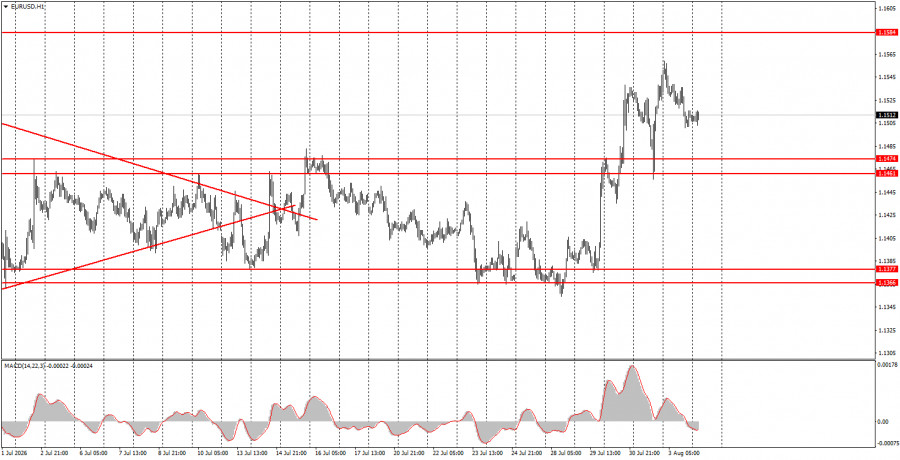
On Monday, the EUR/USD currency pair slightly corrected, but the upward trend remains intact. On the hourly timeframe, it's clear how much time the price spent inside the sideways channel, bounded by two price areas: 1.1366-1.1377 and 1.1461-1.1474. Currently, the pair has not only left this range but also tested it from above and bounced off. On the daily and weekly timeframes, it is evident that the European currency bounced off the lower boundary of the sideways channel, where it has been for a year. Therefore, all technical factors are in favor of the euro.
Let's remind novice traders that if it weren't for the geopolitical conflict in the Middle East, which sharply increased demand for the "safe dollar," the U.S. currency would not have shown such strong growth in 2026. At the beginning of the year, the Federal Reserve was preparing to resume its monetary policy easing cycle, which clearly does not support the strengthening of the American currency. Moreover, Donald Trump's policy is aimed, in one way or another, at weakening the dollar. Thus, in the medium term, we expect only euro growth, and this week only the U.S. labor market data could hinder this.
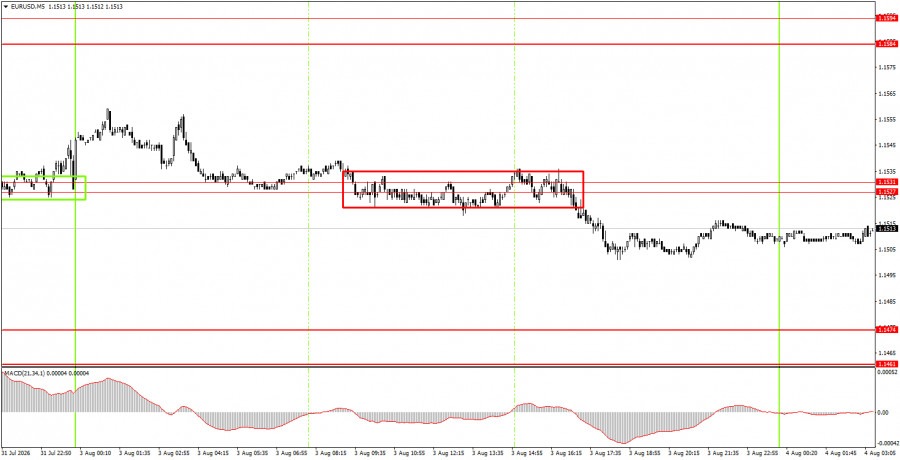
On the 5-minute timeframe, a trading signal was formed on Monday that novice traders could easily take advantage of. During the American trading session, the price "pulled away" from the 1.1527-1.1531 area, allowing short positions to be opened. By evening, the trade could be closed with a profit of about 20 pips, or left open until Tuesday.
On the hourly timeframe, the price has left the sideways channel it had been in for a month. Considering recent global events, we believe the European currency should continue its steady growth. Recently, the market has diligently ignored almost all factors in favor of the euro, so a "mutual settlement" may now begin, bringing the exchange rate to fair value.
On Tuesday, novice traders may remain in short positions with a target of 1.1461-1.1474, as the price consolidated below the area of 1.1527-1.1531 on Monday. New long positions can be initiated if consolidation occurs above the 1.1527-1.1531 area, with targets of 1.1584-1.1594.
On the 5-minute timeframe, the following levels should be considered: 1.1267-1.1275, 1.1366-1.1377, 1.1461-1.1474, 1.1527-1.1531, 1.1584-1.1594, 1.1655-1.1666, 1.1745-1.1754. On Tuesday, there are no significant reports planned in the Eurozone, while the U.S. will release one of the less important JOLTs reports on open job vacancies for June. This data is quite outdated, so we do not expect a strong market reaction.
Support and resistance price levels (areas) are the targets when opening buy or sell orders or sources of signals. Red lines denote channels or trend lines that reflect the current trend and indicate in which direction trading is currently favored. The MACD indicator (14,22,3) – histogram and signal line – is a supporting indicator that can also be used as a source of signals.
Important speeches and reports (as listed in the news calendar) can significantly influence the movement of the currency pair. Therefore, during their release, trading should be approached with utmost caution, or one should exit the market to avoid sharp price reversals against the preceding movement.
Beginners in Forex trading should remember that not every trade can be profitable. Developing a clear strategy and proper money management are essential for long-term trading success.

PAUTAN SEGERA
ForexMart is authorized and regulated in various jurisdictions.
(Reg No.23071, IBC 2015) with a registered office at First Floor, SVG Teachers Co-operative Credit Union Limited Uptown Building, Corner of James and Middle Street, Kingstown, Saint Vincent and the Grenadines
Restricted Regions: the United States of America, North Korea, Sudan, Syria and some other regions.










 Hubungi Kami