Review of Trades and Trading Tips for the Euro
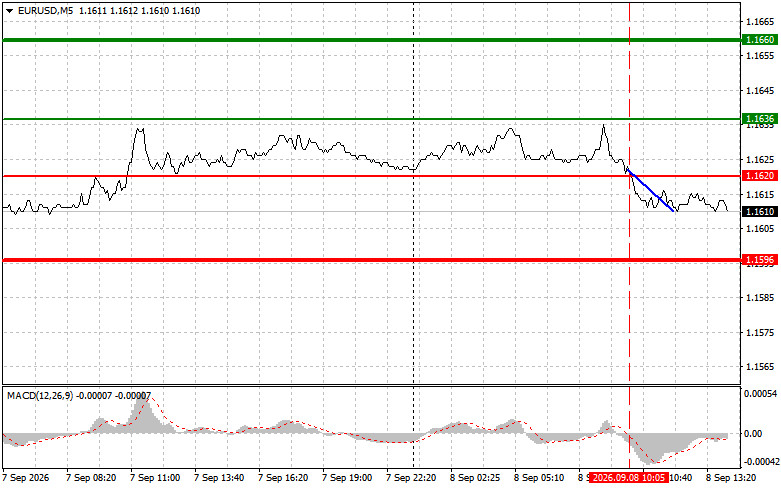
The test of the 1.1620 price level occurred when the MACD indicator had just started moving downward from the zero line, confirming that this was an appropriate entry point for a short position on the euro. As a result, the pair declined by only 10 points.
Conflicting trade statistics from Germany and France failed to provide support for the euro, which, in my view, was to be expected. The German data looked positive only at first glance, as the surplus widened not because exports increased, but because imports contracted sharply, which is a direct sign of weak domestic demand. France, meanwhile, moved in the opposite direction, with its deficit widening, and the divergent results from the two largest economies in the bloc effectively deprived the data of any clear directional signal for the currency. This is precisely why the euro barely reacted, as traders are currently looking at factors other than the trade balance.
The euro will spend the second half of the day awaiting secondary U.S. economic data, namely the NFIB Small Business Optimism Index and consumer credit data. The NFIB index measures small businesses' confidence in the economy, while consumer lending helps assess consumers' willingness to spend, and these channels allow the reports to influence expectations regarding Fed policy. Nevertheless, both indicators carry limited weight, so I would not expect a significant reaction. The outlook for the single currency is cautious, as strong U.S. data could allow the dollar to extend its morning gains and put pressure on EUR/USD. I believe that until the ECB meeting on September 10, the euro will remain dependent on external factors, and secondary U.S. data are unlikely to outweigh the impact of interest-rate expectations and overall sentiment toward the dollar. A weak result, meanwhile, would provide the single currency with only a brief respite.
As for the intraday strategy, I will focus more on the implementation of Scenarios #1 and #2.
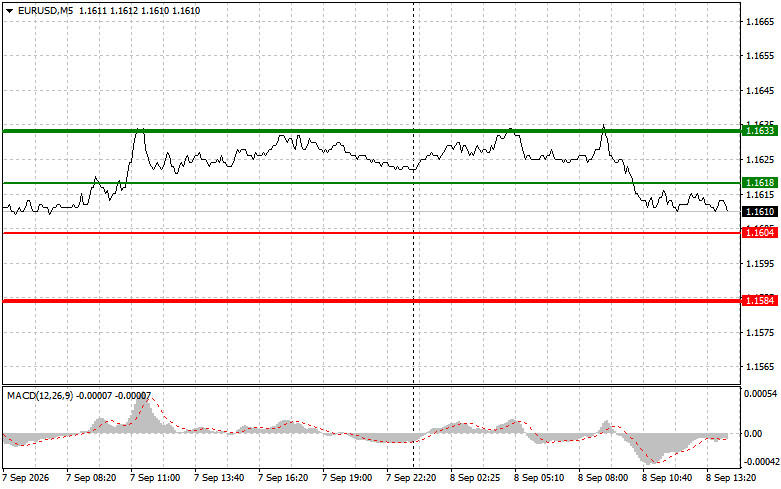
Scenario #1: Today, the euro can be bought when the price reaches around 1.1618 (the green line on the chart), with a target of 1.1633. At 1.1633, I plan to exit the market and also sell the euro in the opposite direction, targeting a move of 30–35 points from the entry point. The euro can be expected to rise today only if U.S. data are weak. Important! Before buying, make sure that the MACD indicator is above the zero line and has only just begun to rise from it.
Scenario #2: I also plan to buy the euro today if the price tests 1.1604 twice consecutively while the MACD indicator is in the oversold area. This would limit the pair's downward potential and lead to an upward reversal. A rise toward the opposite levels of 1.1618 and 1.1633 can be expected.
Scenario #1: I plan to sell the euro after the price reaches 1.1604 (the red line on the chart). The target will be 1.1584, where I plan to exit the market and immediately buy in the opposite direction, targeting a reverse move of 20–25 points from the level. Pressure on the pair will return if the economic data are strong. Important! Before selling, make sure that the MACD indicator is below the zero line and has only just begun to decline from it.
Scenario #2: I also plan to sell the euro today if the price tests 1.1618 twice consecutively while the MACD indicator is in the overbought area. This would limit the pair's upward potential and lead to a downward reversal. A decline toward the opposite levels of 1.1604 and 1.1584 can be expected.
Important. Beginner Forex traders should exercise extreme caution when making market-entry decisions. Before the release of important fundamental reports, it is best to stay out of the market to avoid exposure to sharp exchange-rate fluctuations. If you decide to trade during news releases, always place stop orders to minimize losses. Without stop orders, you can lose your entire deposit very quickly, especially if you do not use proper money management and trade large volumes.
And remember that successful trading requires a clear trading plan, such as the one presented above. Making spontaneous trading decisions based on the current market situation is inherently a losing strategy for an intraday trader.
PAUTAN SEGERA
ForexMart is authorized and regulated in various jurisdictions.
(Reg No.23071, IBC 2015) with a registered office at First Floor, SVG Teachers Co-operative Credit Union Limited Uptown Building, Corner of James and Middle Street, Kingstown, Saint Vincent and the Grenadines
Restricted Regions: the United States of America, North Korea, Sudan, Syria and some other regions.










 Hubungi Kami