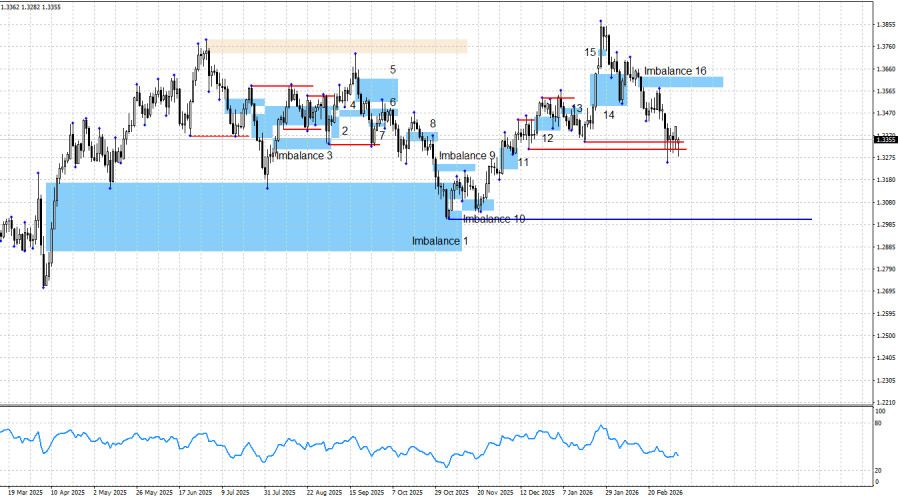
The GBP/USD pair continues its decline within a "bullish" trend. The only working pattern remains the "bearish" imbalance 16, but the price has not yet managed to work it out, so traders have been left without a signal to sell. Perhaps that is for the better. The pair's decline over the past 8 days is clearly visible now. However, it was caused exclusively by the continuously worsening situation in the Middle East. And predicting such events is usually extremely difficult. Let me remind you that traders are interested in situations where movements can be predicted with a high degree of probability. This morning many media outlets reported that the overnight rise of the dollar was linked to a sharp increase in oil prices, while the subsequent pullback was caused by a similar pullback in oil. How could anyone have predicted the rise of black gold to $119 and then its fall to $101 within a few hours? Thus, the morning currency movements could not have been predicted either. Moreover, there are currently no working patterns near the price. Traders can now rely only on a liquidity sweep for buying from the last two "bearish" swings. Perhaps this warning signal will work, but a liquidity sweep is not a pattern that provides traders with a clear zone of interest, upon the retest of which trades can be opened.
At the moment there are no "bullish" patterns, and the price is unlikely to return to imbalance 16 in the near future and on the second attempt provide traders with the necessary signal. In my opinion, if no new escalation occurs in the Middle East over the next few days, demand for the dollar will begin to decline. Over the past five days bears have been attacking much more weakly than before, although the war in Iran continues and energy prices are "soaring." Nevertheless, the former aggressive attacks from the bears are no longer being observed.
The "bullish" trend for the pound remains. Thus, as long as it remains in place (above the level of 1.3012), I would pay more attention to "bullish" signals. The decline of the pound may be quite strong, but now bears need new reasons for further attacks. The dollar will no longer be able to rely on the mere fact of war alone. The market ignored U.S. statistics last week and does not want to sell the dollar in favor of other currencies. However, this will not always be the case. Today, during the day, bulls are once again trying to go on the offensive.
The news background on Monday was absent, and after the overnight decline bulls are again trying to pull the rope away from the bears. In my opinion, this week we will see the pound rise at least due to a liquidity sweep from the last two swings. How strong it will be will determine the further prospects for the pound.
In the United States, the overall information background remains such that, in the long term, nothing except a decline of the dollar can be expected. And the war between Iran and the United States has changed little so far. The situation for the U.S. dollar remains quite difficult in the long term and positive in the short term. But the point is that it is positive only in the short term. U.S. labor market statistics continue to disappoint more often than they please. Three of the last four FOMC meetings ended with a "dovish" decision. Trump's military aggression, threats toward Denmark, Mexico, Cuba, Colombia, EU countries, Canada, and South Korea, the initiation of criminal proceedings against Jerome Powell, "shutdowns," the scandal involving the U.S. elite in the Epstein case, the possible impeachment of Trump by the end of the year, and the very likely defeat of the Republicans in the elections perfectly complement the current picture of a political and structural crisis in America. In my opinion, bulls have everything needed to resume the offensive during 2026.
For a "bearish" trend a strong and stable positive news background for the dollar is required, which is difficult to expect under Donald Trump. Therefore, I still do not believe in a "bearish" trend for the pound. Too many risk factors remain hanging like dead weight on the dollar. From "bearish" patterns it is possible to consider opening sell trades, but personally I would not recommend this to traders. I consider the recent decline of the pair to some extent a coincidence of circumstances.
Calendar of events for the U.S. and the U.K.:
On March 10, the calendar of economic events does not contain important entries. The influence of the news background on market sentiment on Tuesday will be weak or absent. Most likely the latter.
Forecast for GBP/USD and advice for traders:
For the pound the long-term picture remains "bullish." There are currently no relevant "bullish" patterns, only a "bearish" imbalance, to which the price must first return and receive a reaction before traders can consider the potential opportunity to open sell trades.
I would note that the decline of the pound in recent weeks turned out to be strong enough to transform the "bullish" picture into a "bearish" one due to an unfortunate combination of circumstances. If Donald Trump had not promised every other day to attack Iran, had not sent warships to the Persian Gulf, and then had not started a war, we would hardly have seen such strong growth of the dollar. I believe this decline may end as unexpectedly as it began. The starting point for bulls already this week may be the liquidity sweep from the lows of 1.3341 and 1.3310.
QUICK LINKS
ForexMart is authorized and regulated in various jurisdictions.
(Reg No.23071, IBC 2015) with a registered office at First Floor, SVG Teachers Co-operative Credit Union Limited Uptown Building, Corner of James and Middle Street, Kingstown, Saint Vincent and the Grenadines
Restricted Regions: the United States of America, North Korea, Sudan, Syria and some other regions.










 Contact Us