Trade Review and Trading Tips for the Japanese Yen
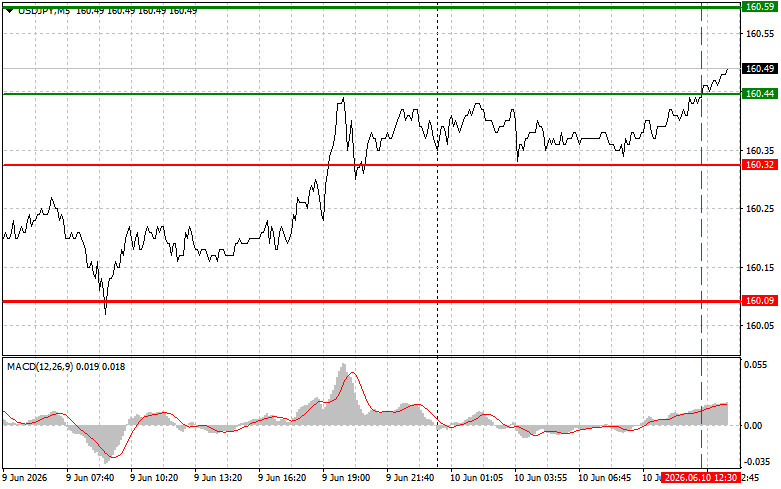
A test of the 160.44 level occurred at a time when the MACD indicator had already moved significantly above the zero line, which limited the pair's upward potential.
The Japanese yen continues to weaken against the U.S. dollar, as today's U.S. inflation data may encourage traders to continue buying USD/JPY. However, it should not be forgotten that the pair has already moved beyond the Bank of Japan's psychological level of 160 yen, so currency intervention may occur at any moment—especially in the case of further yen weakening—which could lead to a sharp decline in USD/JPY.
Regarding inflation, traders will most likely focus more on the Core CPI. To better understand inflation dynamics, this indicator is often analyzed in detail. By excluding the most volatile components such as food and energy prices, it provides a clearer picture of long-term inflation trends that are less affected by short-term fluctuations. An increase in Core CPI is also viewed as a positive signal for the U.S. dollar and a negative factor for the Japanese yen.
Regarding intraday strategy, I will primarily rely on Scenario #1 and Scenario #2.
Buy Signal
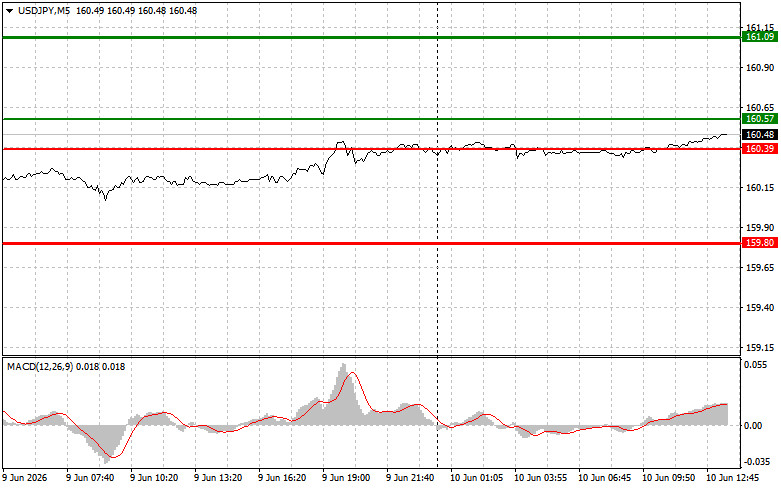
Scenario #1: I plan to buy USD/JPY today at an entry point around 160.57 (green line on the chart), targeting a rise toward 161.09 (thicker green line on the chart). At 161.09, I will exit long positions and open short positions in the opposite direction (expecting a 30–35 point move in the opposite direction from that level). A further rise in the pair today is possible in the case of strong U.S. inflation data. Important: Before buying, ensure that the MACD indicator is above the zero line and has just started moving upward from it.
Scenario #2: I also plan to buy USD/JPY if there are two consecutive tests of the 160.39 level while the MACD is in oversold territory. This would limit downward potential and trigger a reversal to the upside. In this case, a move toward 160.57 and 161.09 can be expected.
Sell Signal
Scenario #1: I plan to sell USD/JPY after a break below the 160.39 level (red line on the chart), which should lead to a rapid decline in the pair. The key downward target is 159.80, where I will exit short positions and immediately open long positions in the opposite direction (expecting a 20–25 point rebound from that level). Downward pressure on the pair may return in the case of central bank intervention. Important: Before selling, ensure that the MACD indicator is below the zero line and has just started moving downward from it.
Scenario #2: I also plan to sell USD/JPY if there are two consecutive tests of the 160.57 level while the MACD is in overbought territory. This would limit upward potential and trigger a reversal to the downside. A decline toward 160.39 and 159.80 can be expected.
What Is on the Chart:
Important: Beginner Forex traders should be extremely cautious when entering the market. Ahead of important fundamental data releases, it is best to stay out of the market to avoid sharp price volatility. If you choose to trade during news releases, always place stop-loss orders to minimize losses. Without stop-loss orders, you may quickly lose your entire deposit, especially if risk management is not applied and large position sizes are used.
Remember that successful trading requires a clear trading plan, similar to the one presented above. Spontaneous trading decisions based on current market conditions are inherently a losing strategy for intraday traders.

QUICK LINKS
ForexMart is authorized and regulated in various jurisdictions.
(Reg No.23071, IBC 2015) with a registered office at First Floor, SVG Teachers Co-operative Credit Union Limited Uptown Building, Corner of James and Middle Street, Kingstown, Saint Vincent and the Grenadines
Restricted Regions: the United States of America, North Korea, Sudan, Syria and some other regions.










 Contact Us