
July 2026 will enter the history of the currency market as the month when Japan and the U.S. jointly united for the first time in 15 years to defend the yen. Against the backdrop of the Bank of Japan's meeting, which ended with a "hawkish pause," the joint intervention dropped USD/JPY from 40-year highs. However, whether this effect will persist remains to be seen.
On July 30-31, 2026, the BoJ held a two-day meeting, at the conclusion of which it decided to maintain the key interest rate at 1.0%. This decision was expected, but important signals were hidden behind the external restraint. First, one board member voted for an immediate rate hike. Second, the BoJ lowered its inflation forecast while raising its GDP forecast for the 2026 fiscal year. And third, the markets were sent a clear signal—inflation was announced as "approaching 2%," which was seen as making it likely that the rate could be raised not in December but in October.
The USD/JPY pair reached a 40-year low of 163.99 on July 23, 2026. However, by July 30, the situation changed dramatically. Within hours, the pair dropped from 162.8 to 157.4. The reason—massive intervention confirmed by Japan's Finance Minister Satsuki Katayama on July 31. However, the key distinction from previous operations was the U.S.'s involvement.
U.S. Treasury Secretary Scott Bessent personally initiated the purchase of yen. Journalists noted a message on his tablet during a meeting in Camp David: "Buy Japanese yen (JPY) $5-10 billion." Later, he stated that the U.S. would do "everything necessary" to stabilize the yen.
Analysts estimate that on July 30, Japan spent about 8.45 trillion yen (~$53 billion) to purchase yen—likely the largest single-day intervention in Japan's history. The second day of the operation was jointly conducted.
The market reacted instantly—USD/JPY fell to 155.23, the lowest level since May 2026; Japanese stocks received a boost from the strengthening yen and falling oil prices, bearish positions on the yen were wiped out, and trading on July 30 was accompanied by an abnormal volume (~$27 billion in one day) and numerous stop-losses.
The key level to watch is 155. Bank of America refers to it as the bifurcation point: consolidation below this level would change market psychology from "buying the dip on USD/JPY" to "selling the rise," potentially triggering a self-sustaining strengthening of the yen.
The net short position on the yen increased during the reporting week to -12.9 billion, while the total volume of hedge funds' short positions approached a peak not seen since 2007. The calculated price is significantly above the long-term average, but after the intervention, it has lost direction.
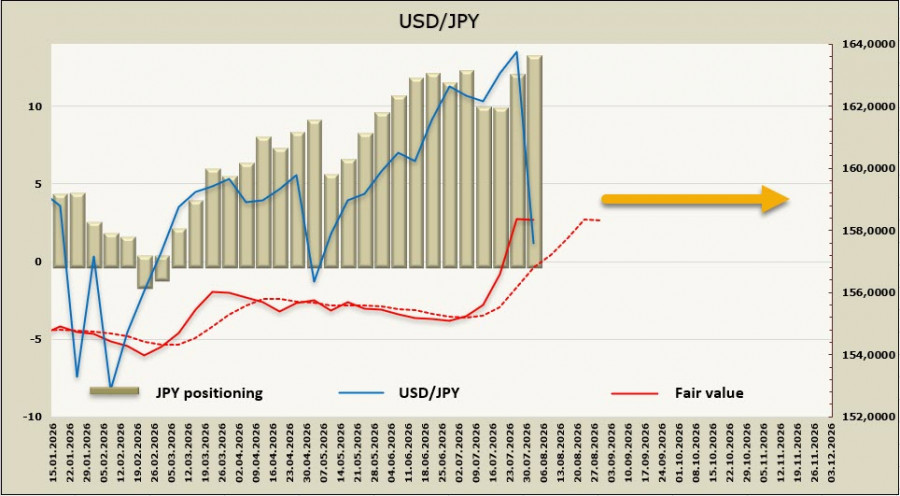
Currently, the USD/JPY pair is near the trend line of 157.50/158.00, and despite the impressive surge to 155.24, it has not managed to consolidate below this line. It is unclear whether the threat of further interventions remains (according to IMF rules), but if U.S. inflation data on August 12 exceed forecasts, a return to 160 is likely.
For the yen to continue strengthening, a synergistic effect involving at least two of three factors is needed: a more aggressive rate hike by the BoJ, a reduced likelihood of a Federal Reserve rate hike, and falling oil prices. So far, its weakness remains fundamentally unchallenged.
QUICK LINKS
ForexMart is authorized and regulated in various jurisdictions.
(Reg No.23071, IBC 2015) with a registered office at First Floor, SVG Teachers Co-operative Credit Union Limited Uptown Building, Corner of James and Middle Street, Kingstown, Saint Vincent and the Grenadines
Restricted Regions: the United States of America, North Korea, Sudan, Syria and some other regions.










 Contact Us