As we have already discussed, Donald Trump's war in Iran has brought about the downfall of his own, not particularly high, political ratings, and he is now virtually guaranteed to lose the midterm elections in November. However, the list of the American leader's "achievements" does not end there. Just a month or so ago, Trump was pleased with the decline in the US dollar, which significantly improved the US trade balance. The lower the value of the American dollar, the more competitive American companies' products become in global markets. This makes sense. Demand for US goods increases, and not just for goods. The same oil and gas are also sold by America for dollars, and the cheaper the dollar, the more countries will voluntarily want to purchase energy resources from the US.
However, over the past seven weeks, the American currency has risen against the euro by 6 cents and against the British pound by 5 cents. If we take some median values over the long term, the dollar is not much cheaper compared to the "pre-Trump era," despite all the events of last year. The market has recalled the dollar's status as a "safe currency," and with the beginning of the war in the Middle East, the American currency has been rising not by days but by hours. It has become clear that, despite criticism of the dollar stemming from Trump's policies, no alternatives to the dollar have yet been devised. The euro and pound have once again demonstrated their weakness and dependence on external energy resources, and Bitcoin has not proven to be an asset that can replace fiat dollars in challenging times.
Therefore, I do not rule out that Trump's conciliatory rhetoric is aimed not only at stabilizing oil prices but also at stabilizing the dollar's exchange rate. Already today, despite Iran's denials, the EUR/USD instrument has moved above the 16 figure, and the GBP/USD instrument has risen above the 34 figure. This is just one day, just one conciliatory statement from Trump. With his remarks on negotiations, the US president sent an important message to Tehran: he is open to a ceasefire. It is uncertain whether Tehran will agree to a ceasefire, but I do not think it is in its interest to wage war with multiple countries for several more years. Iran is prepared for a prolonged conflict, but does it want that? As the saying goes, a bad peace is better than a good quarrel. Therefore, in my opinion, the conflict in the Middle East is gradually moving toward resolution. Trump has not achieved his set goals, so why continue the war?
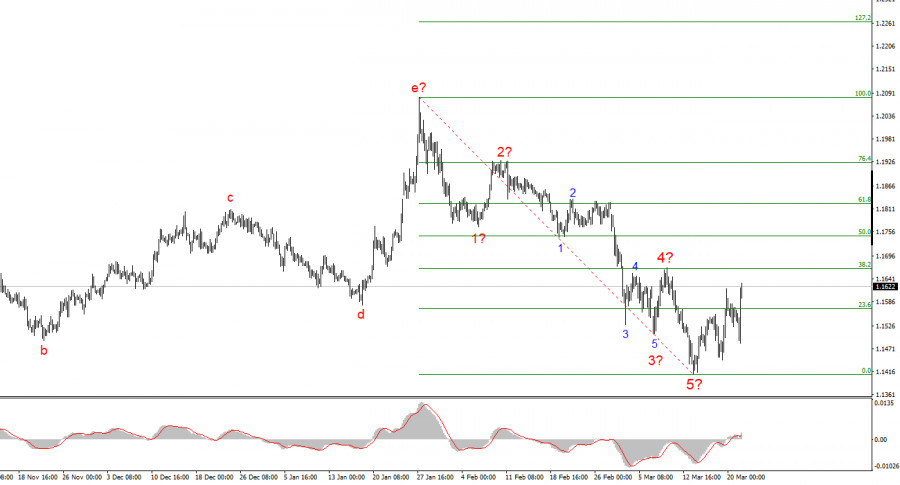
Based on the conducted analysis of EUR/USD, I conclude that the instrument remains within an upward section of the trend (bottom picture), while in the short term, it has completed the construction of a downward wave set. Since the five-wave impulse structure is complete, in the next week or two, my readers can expect a rise in quotes, with targets around 1.1666 and 1.1745, which correspond to the 38.2% and 50.0% Fibonacci. Further movements of the instrument fully depend on events in the Middle East.
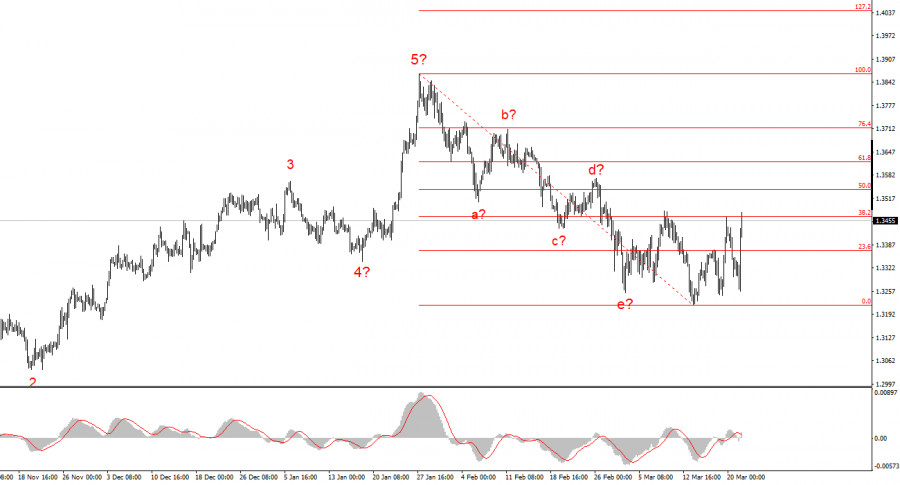
The wave picture for the GBP/USD instrument has become very complex and difficult to read. Now we see a seven-wave downward structure on the charts, which is undoubtedly not that. Most likely, there is elongation or complication within one of the waves. However, this does not make the wave layout clearer. If the wave picture has once been complicated to an unreadable form, it may be complicated several more times. Therefore, I believe it is best to rely on the wave layout of the EUR/USD instrument, which appears much clearer. Consequently, I also expect the pound to rise, with targets around 1.3541 and 1.3620. Moreover, one should not forget about the geopolitical factor, which could send both instruments into a new decline at any moment.
QUICK LINKS
ForexMart is authorized and regulated in various jurisdictions.
(Reg No.23071, IBC 2015) with a registered office at First Floor, SVG Teachers Co-operative Credit Union Limited Uptown Building, Corner of James and Middle Street, Kingstown, Saint Vincent and the Grenadines
Restricted Regions: the United States of America, North Korea, Sudan, Syria and some other regions.







 Contact Us