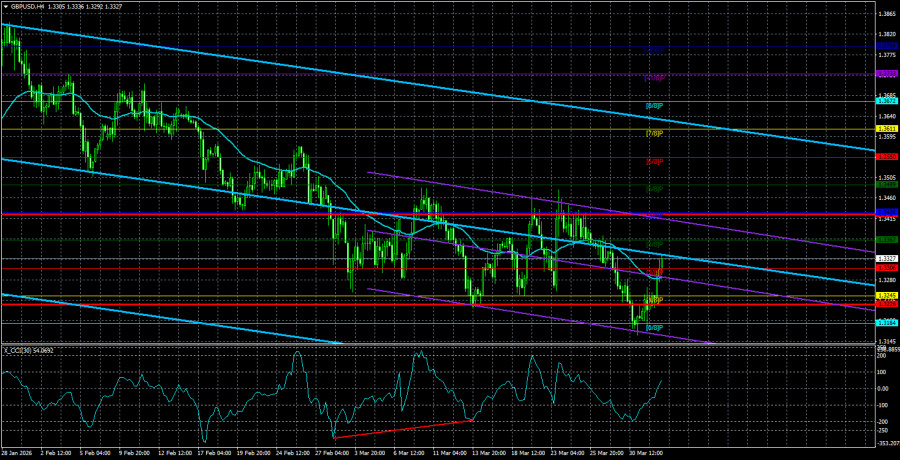
The GBP/USD currency pair continued its upward movement on Wednesday amid a decrease in tension surrounding Iran. Donald Trump has been talking for more than a week about the imminent end of the war in the Middle East and a deal, and yesterday it became known that Tehran has finally decided to embark on a path of de-escalation, as reported by the country's president, Masoud Pezeshkian. This was indeed the key reason for the pair's growth over the last two days.
Of course, one should not forget about rising inflation in Germany and the EU, the likely increase in inflation in Great Britain, the probable tightening of monetary policy by the Bank of England and the ECB, and Jerome Powell's speech on Monday. All of these factors could also support the euro and pound. However, it is unlikely that anyone would deny that the geopolitical factor remains key for the currency market. Even now, when the situation in the Middle East offers a real chance of pacification, geopolitics remains the key factor, as its influence on the market is weakening. Now, the euro and the pound can rise every day because investors have stopped fleeing to the safe dollar.
What is the paradox of the US dollar mentioned in the article's headline? For the past month and a half, the dollar has ignored all the negativity directed at it. Traders have paid no attention to the dismal reports from across the ocean, the hawkish tone from representatives of the Bank of England and the ECB, or technical factors. Now, the situation may repeat itself in reverse. The euro and the pound could rise without being tied to fundamentals, macroeconomics, or technical analysis. The dollar may lose its only support, while the euro and the pound could spread their wings.
If this is the case, the British pound could quickly and easily return to the highs of the year, in the range of 1.3600-1.3800. In fact, it only needs to rise by about 300 pips to reach that range. Of course, this will take some time, but, for example, this week's unemployment and labor market reports will be published in the US. If they once again show "mind-blowing" values, the dollar will fall much more cheerfully.
It is also worth noting that the market has only just begun to price in the de-escalation scenario. So far, there has been no announcement of successful negotiations, no deal, and no end to the war. Each such announcement will provoke a decline in the US dollar and an increase in risk assets. Therefore, if the war concludes, the GBP/USD pair will have plenty of opportunities to quickly and painlessly return to the 1.36-1.38 range.
We still believe the upward trends of 2022 and 2025 are not over. No one could have predicted the events of March in the Middle East, which is why we saw a movement that no one anticipated. In some cases, the sharp rise of the dollar broke the technical picture, but for the British pound on the daily timeframe, everything looks roughly the same as it did a month ago. On the weekly timeframe, it is even more so. Yes, the pair showed a stronger correction than expected, but nothing more than that.
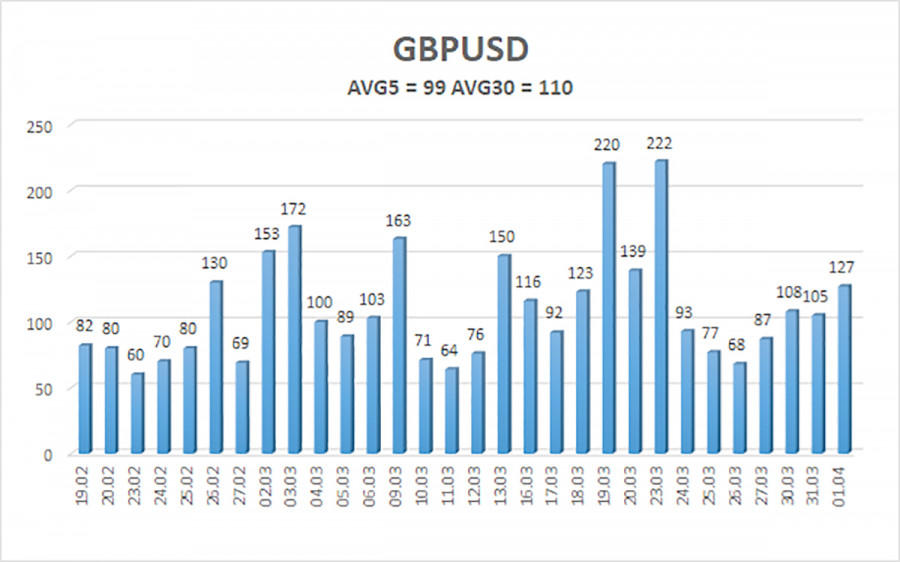
The average volatility of the GBP/USD pair over the last 5 trading days is 99 pips. For the pound/dollar pair, this value is considered "average." On Thursday, April 2, we expect movement within a range bounded by 1.3226 and 1.3424. The upper channel of the linear regression has turned downward, indicating a change in trend. The CCI indicator has entered the oversold area twice and also formed a "bullish" divergence, which once again warned of the completion of the downward trend. However, geopolitics is currently more important than technical signals.
S1 – 1.3306
S2 – 1.3245
S3 – 1.3184
R1 – 1.3367
R2 – 1.3428
R3 – 1.3489
The GBP/USD currency pair has been moving downward for a month and a half, but its long-term prospects have not changed. Donald Trump's policies will continue to exert pressure on the US economy, so we do not expect the US currency to grow in 2026. Thus, long positions with a target of 1.3916 and above remain relevant as long as the price is above the moving average. If the price is below the moving average line, shorts can be considered with targets of 1.3226 and 1.3184 based on geopolitical factors. In recent weeks, almost all news and events have been negative for the British pound, prolonging the downward trend.
Linear regression channels help define the current trend. If both are oriented in the same direction, it indicates that the trend is strong;
The moving average line (settings 20.0, smoothed) defines the short-term trend and the direction in which trading should currently be conducted;
Murray levels are target levels for movements and corrections;
Volatility levels (red lines) represent the probable price channel in which the pair will remain over the next day, based on current volatility indicators;
The CCI indicator entering the oversold area (below -250) or the overbought area (above +250) indicates that a trend reversal in the opposite direction is approaching.
QUICK LINKS
ForexMart is authorized and regulated in various jurisdictions.
(Reg No.23071, IBC 2015) with a registered office at First Floor, SVG Teachers Co-operative Credit Union Limited Uptown Building, Corner of James and Middle Street, Kingstown, Saint Vincent and the Grenadines
Restricted Regions: the United States of America, North Korea, Sudan, Syria and some other regions.










 Contact Us